Florida Board of Education sets AI rules for school districts, public colleges
Published in News & Features
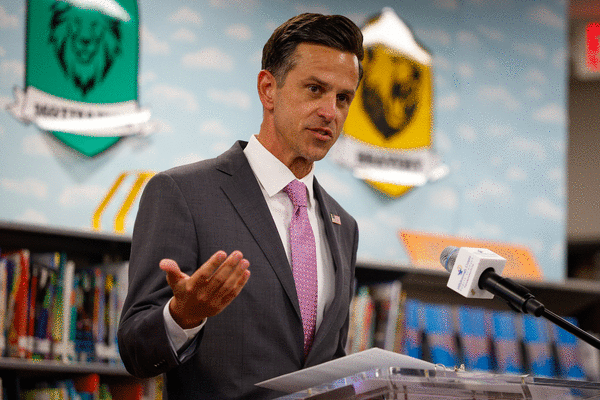
The Florida Board of Education on Wednesday approved guidelines restricting the use of artificial intelligence in K-12 schools and public colleges.
The rules are intended to safeguard students from inappropriate content while allowing teachers access to high-quality educational tools, said Paul Burns, senior chancellor at the state Department of Education.
Education Commissioner Henry Mack said AI should enhance learning, not replace it.
“We are neither going to one extreme, i.e. banning AI, nor are we going to the other extreme, which is just unfettered access,” he said.
Under the new rules, any students in prekindergarten through 12th grade must only use autonomous AI tools under the direct supervision of an adult. AI must also never be used to make decisions without human review.
Districts must notify parents when an AI tool is approved for instructional use and give them the option to opt into, rather than out of using the tool.
Critics of the guidelines initially said the rules are too broad and would limit teachers’ options to use technology to help students with disabilities.
The policy, as presented on Wednesday, defines AI as a machine-based system that operates through a continuous cognitive loop and executes actions as well as gathering or generating datasets with minimal or no human oversight.
Maya Israel, the co-director of Florida’s K-12 AI Education Task Force and a professor at the University of Florida, said the new rules show an intent around data privacy, parental consent and making sure students are safe.
Those ideas have always been the bedrock of the task force’s recommendations, too, she said.
School districts must also ensure that AI tools proposed for use in prekindergarten through fifth grade go through additional review to make sure they are age and developmentally appropriate. The new policy requires that AI tools are viewpoint-neutral and do not subject students to undisclosed monitoring.
School districts must also now require teacher and administrator training regarding AI risks and safety and keep a publicly accessible list of approved AI teaching tools.
Districts and colleges must not use AI tools that are designed to simulate friendship or any emotional relationship with a student.
The new rules also require colleges to notify parents of minors using AI in their classes and prohibit students from using AI to work on any graded assignment unless approved by their instructor.
The policy is much more explicit about parental choice and providing alternatives to AI, Israel said. School districts will likely grapple with what that looks like and how to come up with alternative programs for students.
Districts and colleges alike need to understand how research-backed AI instruction looks, she said.
“But the tools are moving very quickly, shifting very quickly, and so that’s a real big challenge,” she said. “The other challenge is around professional development. We want to make sure that teachers are aligning their instruction to best practice.”
_____
©2026 Tampa Bay Times. Visit tampabay.com. Distributed by Tribune Content Agency, LLC.






Comments