How 9/11 changed the way America surveils its citizens
Published in News & Features
Twenty-five years after 9/11, the surveillance infrastructure built and expanded in its aftermath has become part of a far larger digital ecosystem — producing tools that can collect and analyze information on a scale unimaginable in 2001.
The terrorist attacks of Sept. 11, 2001, did more than reshape the nation’s approach to terrorism. They changed the architecture of American intelligence and policing. They expanded how government agencies collect, share and analyze information, and brought national security tools deeper into ordinary law enforcement.
The infrastructure built in the attacks’ aftermath has proved remarkably durable. Joint terrorism task forces and fusion centers brought federal, state and local agencies into closer intelligence-sharing networks. New laws expanded the government’s ability to obtain information. And police departments acquired technologies that once belonged largely to the realm of national security.
But the expansion of surveillance did not go uncontested. Civil liberties groups warned that the new powers could erode Americans’ privacy and constitutional protections, while many Americans accepted expanded government surveillance as a necessary trade-off for safety in the aftermath of the attacks.
The country also entered a period of heightened scrutiny for people perceived as foreign or potentially threatening — with American Muslims and immigrant communities bearing a particularly heavy burden.
Then came the digital revolution.
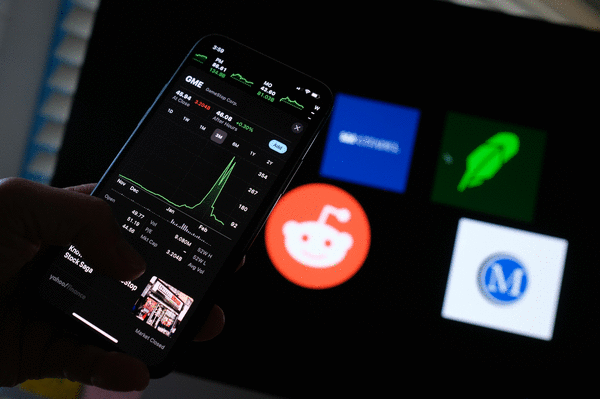
Americans began carrying smartphones, broadcasting their lives on social media and generating enormous amounts of commercially collected data. Police gained access to license plate readers, networks of cameras, cellphone location information and other technologies capable of tracking people and mapping their movements.
Now, artificial intelligence is adding another layer: systems that can sift through those vast stores of information, connect previously separate databases and generate analyses in seconds.
Some surveillance and privacy experts say that the amount of information available to the government — and its ability to make sense of it — has fundamentally changed since 9/11.
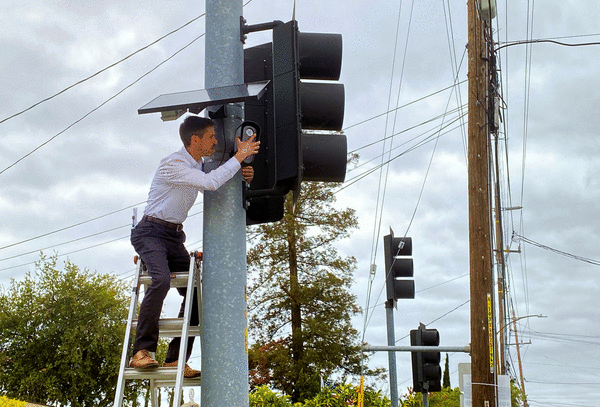
That has taken on new urgency as surveillance systems have moved further into everyday life. Automated license plate readers can track where people drive. Facial recognition can help identify people in crowds. Commercial data can reveal where and how people live and travel. And increasingly, artificial intelligence can analyze and connect these streams of information at a speed no human investigator could match.
Those capabilities have raised concerns among some experts and advocates about how surveillance could be used to monitor protests, track immigrants and identify people seeking reproductive healthcare.
Gregory Nojeim, senior counsel and director of the security and surveillance project at the Center for Democracy & Technology, described the post-9/11 era as a “perfect storm.”
“That storm is both the expansion of the legal powers that have been conferred on the government to collect and share information, combined with the advance of technology, which has given the government more tools to collect information from more people in more contexts,” Nojeim said.
From intelligence silos to everyday policing
In the months after 9/11, officials sought to fix a critical weakness exposed by the attacks: Intelligence that could have helped uncover the plot was held across government agencies that failed to connect or share it effectively. The response was a sweeping effort to tear down those silos and build a more integrated intelligence network.
Federal, state and local agencies quickly expanded intelligence-sharing, and the government established and expanded networks designed to move information across traditional institutional boundaries. The FBI’s Joint Terrorism Task Forces brought together federal, state and local law enforcement and intelligence personnel.
Fusion centers, generally run by state and local governments with federal support, became another part of the post-9/11 intelligence architecture, with at least one operating in every state. The centers serve as intelligence hubs where law enforcement agencies can share information, analyze data and flag potential threats across jurisdictions.
Katie Kinsey, chief of staff and tech policy counsel at the Policing Project at the NYU School of Law, said the original goal was straightforward — prevent another terrorist attack.
Over time, some fusion centers began supporting investigations and enforcement involving lower-level crimes, Kinsey said. Local police departments also developed their own versions of centralized intelligence hubs, often called real-time crime centers, that can integrate information from cameras, automated license plate readers and other surveillance systems.
David Viola, an adjunct professor at the Center on Terrorism at John Jay College of Criminal Justice and author of “You Have Unleashed a Storm: New York City’s Descent into Chaos During America’s Most Explosive Era of Radical Violence,” said the post-9/11 period also marked a major shift in the kind of information available to investigators.
Before the attacks, he said, intelligence work relied heavily on traditional investigative techniques. Today, digital records can provide information about where people go, with whom they communicate, what they purchase and what they post online.
But technology is only part of the transformation. Viola said the institutional relationships forged among local, state and federal authorities after 9/11 are among the period’s most lasting legacies.
“These are institutions that have cemented the close coordination between state, local, federal, tribal authorities in the past 25 years, and they’re going nowhere, for better or worse,” he said.
Nojeim, of the Center for Democracy & Technology, was directing lobbyists in Washington, D.C., on 9/11. His office was evacuated as officials tried to determine whether the U.S. Capitol was the target of another hijacked plane.
In the aftermath, he said, civil liberties advocates understood that decisions made in response to the attacks could extend far beyond the immediate crisis.
About a month after the attacks, the USA PATRIOT Act was signed into law, dramatically expanding the federal government’s ability to collect information and conduct surveillance in terrorism investigations. Some of its most sweeping surveillance authorities were later curtailed or allowed to expire, but the law helped establish a new framework for national security surveillance that continues to shape how Americans’ data is collected and monitored.
“In the days after 9/11, we all realized that what the government did in the next few days to respond could have lasting implications for the civil liberties of Americans,” Nojeim said.
The data economy
The growth of surveillance after 9/11 also coincided with a separate transformation that would make those systems far more powerful. Americans were beginning to carry smartphones, use social media and spend more of their lives online, generating enormous amounts of digital information that did not exist before.
Kinsey, of the Policing Project, said that created a new dynamic for law enforcement. Agencies had expanded their ability to collect and share intelligence after 9/11, while technology was producing more information about people than ever before. Much of that information was collected by private companies for commercial purposes, but it could also become available to law enforcement, either through data purchases or when companies turned information over to authorities.
At the same time, Kinsey said, Americans have become accustomed to giving up personal information without necessarily understanding how it is collected or what can ultimately be done with it.
“There’s still a lack of awareness because there’s a lack of transparency on the part of law enforcement, but also on the part of these private tech companies about what they are actually collecting on us, and then what they’re doing with that information,” Kinsey said.
That lack of visibility extends beyond the cameras and other surveillance tools people can see. Personal data can be combined and shared behind the scenes, allowing the government to draw conclusions from pieces of information that may seem insignificant on their own.
“Never in human history has the government had more information about what we are doing, who we are doing it with, what we like to buy, and indeed what we are thinking about, than ever before,” said Nojeim, of the Center for Democracy & Technology.
Jessica Katzenstein, a cultural anthropologist and assistant professor at Arizona State University, said technological advances have also changed what Americans consider normal, making forms of live, mass surveillance that once seemed dystopian increasingly commonplace.
“The things that we would have taken for granted as forms of privacy we can all expect have just completely vanished,” she said.
That normalization can make surveillance difficult to roll back once law enforcement agencies have invested in the technology and incorporated it into their work, she said.
“Once you have a sense of both a need and access to tools, it will be very, very difficult to get you to give that up,” said Katzenstein, who also studies police in the U.S. as an ethnographer.
Communities living with the consequences
The expansion of surveillance after 9/11 also had consequences that were not felt equally. American Muslims faced heightened scrutiny in the name of national security, and advocates say the surveillance practices and assumptions that emerged in that period have since affected other communities of color.
Haris Tarin, vice president of policy and programming for the Muslim Public Affairs Council, who also spent more than a decade working in the U.S. Department of Homeland Security, said many American Muslims experienced the aftermath of 9/11 as a “dual attack.”
“We were attacked twice. First by the terrorists, we were attacked for being Americans, and then we were attacked by our own government and people within our own country, where we were cast under suspicion, and that has continued for the last 25 years,” Tarin said.
Tarin said that suspicion soon extended beyond American Muslims to other communities.
“After 9/11, American Muslims were easy to go after because there was not much political consequence,” he said. “But it just didn’t stop with American Muslims. We’ve seen that now extend to immigrants. We’ve seen that now extend to anti-Semitism. We’ve seen that now extend to anti-Black hate.”
Lia Nitake, senior director of technology, telecommunications and media policy at Asian Americans Advancing Justice, said the consequences have been particularly pronounced for communities of color. She said the heightened surveillance of people based on their race, religion or other aspects of their identity has created a climate of fear.
“In a lot of ways, these surveillance measures have also eroded this idea that everyone should have an equal right to privacy,” Nitake said.
Both Tarin and Nitake said the growing use of artificial intelligence raises new concerns about how those disparities could be reproduced or amplified. Police agencies could increasingly rely on technology to monitor communities rather than invest in relationships with them, Tarin said.
“In the AI age, it will be easy for government agencies and law enforcement agencies to use technology to surveil and not do the hard work of community policing and engaging communities,” he said.
Stronger surveillance systems
Police departments nationwide are already using AI-assisted tools to analyze evidence, search databases, draft reports and translate conversations in real time.
North Carolina Central University Police Chief Robert Gaddy, who previously served as a Durham police officer for more than 25 years, sees the technology as a practical response to the growing demands on modern policing.
Information that once had to be gathered and shared manually can now flow through centralized digital systems, while AI-assisted cameras and license plate readers help officers identify suspects, gather evidence and solve crimes.
“If I can take this technology and at least give that (victim’s) security back to them by solving this crime, it’s worth every every bit of it,” Gaddy said.
Gaddy said technology can also help departments facing staffing shortages. But he said its use requires clear limits and oversight, including rules governing how officers access and share information and audits to identify potential misuse.
Still, some experts and advocates worry that newer AI-assisted systems could make existing surveillance infrastructure significantly more powerful by connecting databases that previously operated separately. Some tools allow officers to search multiple databases using natural-language prompts and generate summaries, raising questions about accuracy, missing information and how much officers may rely on the results.
Nojeim, of the Center on Democracy & Technology, said those concerns become especially serious when AI is used in decisions that can affect someone’s liberty.
“We all know from our work or our play with AI that it can make mistakes and that it hallucinates,” he said. “Now we’re in a world where an AI hallucination can be the thing that set off an investigation that landed you in jail inappropriately.”
Modern law enforcement agencies have access to more information than any human could reasonably process, said Viola, the adjunct professor at John Jay College of Criminal Justice. AI could help investigators identify connections that might otherwise be missed. But Viola said those capabilities also come with risks.
“These are very capable tools that can be used to great effect for the betterment of American society and safety,” Viola said. “They can also be used for ill effect if there is an administration who wants to use them for such activity.”
_____
_____
©2026 States Newsroom. Visit at stateline.org. Distributed by Tribune Content Agency, LLC.





Comments