Burnham offers more style than specifics in Parliament debut
Published in News & Features
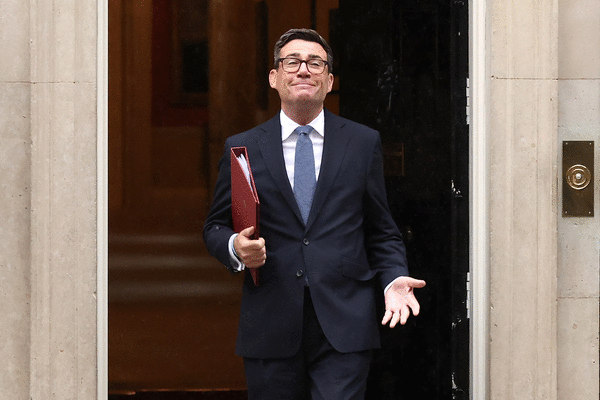
New U.K. Prime Minister Andy Burnham was prepared for a grilling from Conservative leader Kemi Badenoch during his first session of prime minister’s questions in the House of Commons, but the surprise attack came from one on his own backbenchers.
“Defense is definitely one area where vibes alone just isn’t going to be enough,” Labour Member of Parliament Tan Dhesi told the premier, to shouts of agreement from the opposition benches and some raised eyebrows from colleagues on his own side of the chamber.
Dhesi, who chairs the House of Commons defense committee, told Burnham that rather than “kick the can down the road” he should urgently commit to reaching the target of spending 3% of GDP on defense by 2030.
The pointed comments may have touched a nerve for the prime minister who then appeared to misspeak by incorrectly saying he had already made such a commitment. In fact, the U.K. government’s plans as they stand would see defense spending rise to 2.6% next year and only hit 2.7% by 2030.
The Commons exchange highlights how Burnham will soon need to convert his political flair into election-winning policy, and it won’t just be the opposition parties who hold him to account. Although they’re there, too: Badenoch is due to deliver a speech on Thursday outlining her own plans to fund defense, including big cuts to measures dear to Labour MPs.
On his return to Parliament this week for the first time as premier, Burnham has answered around four hours’ worth of questions from MPs about his new-look government and ambitious agenda, yet revealed very little of substance when it comes to policy. He promised a change in approach and a new 10-year plan for the country, but in reality has shown little more than the “vibes” Dhesi complained of.
“Let this country believe in itself again; let people have some hope,” Burnham told the chamber. “That is what this government will do.”
Burnham’s introduction to parliament coincided with the selloff of U.K. bonds in the context of global concern about borrowing, inflation and renewed tensions between the U.S. and Iran. The rise in gilt yields, combined with higher inflation, ramps up pressure on the public finances and is estimated by Bloomberg Economics to cut in half the government’s £23.6 billion ($31.9 billion) headroom.
But instead of offering more clarity over his own spending plans — that will come in the budget, the premier said — Burnham attacked the Tories. He said Badenoch’s party had left the country vulnerable to the global volatility by raising borrowing during its 14 years in power. “The turbulence on global markets are because of the exposure that they left behind,” he said.
Badenoch tried to push him to rule out tax rises or an increase to borrowing but to no avail. Burnham refused to answer her questions directly, saying “I am not going to write the Budget here.” Chancellor of the Exchequer John Healey — who sat next to Burnham in the chamber on Wednesday — is due to deliver the annual set-piece on Oct. 28.
Research published by Bloomberg Economics on Wednesday showed that investor concerns about the government’s fiscal plans were likely amplifying the impact of global bond selloff on gilts. Chris Hopkins, political research director at Savanta, told Bloomberg the additional scrutiny the government agenda now faces will expose “what Burnham is made of, and how his plans will fare in the court of public opinion.”
“Just because anger isn’t being directed at the new prime minister it doesn’t mean Britons aren’t still fed up,” he said. “Burnham presents a degree of renewed hope that he has the answer to some of Britain’s problems, but unless he starts to effectively communicate his solutions and, in the slightly longer term, the public begins to feel the benefit of his policies, his early, relative popularity will be a flash in the pan.”
The PM’s own allies said that the first addresses to parliament are intended to be broad-brush, setting out the direction of his government for the first time in the house after a summer “listening” tour and a series of policy announcements.
This approach presents an opportunity for Burnham’s opponents. Tory MPs and officials said they saw Burnham’s marathon Commons performance on Tuesday as demonstrating style over substance, arguing that for all his rhetoric flourishes he gave little policy detail.
It still remains unclear whether he is serious about nationalizing the water industry or what his language about greater “public control” means in practice, one said. Another warned that he said nothing to reassure investors that his program would be pro-growth and pro-business.
One thing that was clear from Burnham’s first PMQs session was that he has every intention of delivering on his promise to show MPs he offers a more open form of leadership than his predecessor. Burnham even got a gentle telling off from the Commons Speaker Lindsay Hoyle for taking too long over his answers. A day earlier, Burnham had taken more than 100 questions from MPs during a mammoth session. “I understand that I broke records on my first day back for the longest statement in modern history,” he said when opening PMQs.
But the sometimes rambling answers and repeated - seemingly off the cuff - commitments to tackling concerns raised, did not seem to be enough to cheer up those on the Labour benches.
Most of those on the government benches sat behind their new leader with stern – if not nervous – expressions on their face, straining to catch when, or if, Burnham would actually reveal any kind of policy detail.
©2026 Bloomberg L.P. Visit bloomberg.com. Distributed by Tribune Content Agency, LLC.






Comments