Judge 'hesitant' on where to draw the line in lawsuit over immigration enforcement tactics
Published in News & Features
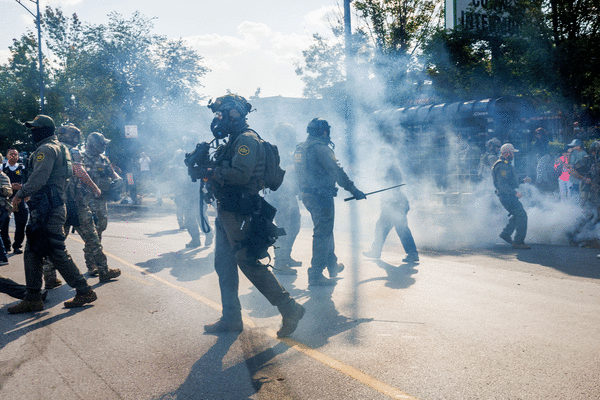
With the anniversary of Operation Midway Blitz less than a week away, the militarized tactics of immigration agents that roiled Chicago last fall were once again front-and-center in federal court on Wednesday as a judge weighs the merits of a lawsuit alleging the Trump administration’s policies are unconstitutional.
But U.S. District Judge Sara Ellis, who last November issued a landmark preliminary injunction limiting the use of force by immigration agents, seemed more skeptical this time around about her ability to police the Justice Department’s enforcement of immigration laws, particularly in light of an appellate court ruling that she’d overstepped her authority.
“Clearly under the separation of powers, I cannot manage the Executive Branch,” Ellis told the parties during the nearly four hours of arguments. “I think I’d said that before, but I’ve been told it again.”
Ellis harkened back to her dramatic decision in a lawsuit brought by the Chicago Headline Club to force then-Border Patrol Cmdr. Greg Bovino, who headed the Midway Blitz operation, to come to court and explain why her orders limiting tear gas and other uses of force on protesters were obviously not being followed.
Ellis said she thought at the time it was well within her role as a judge. But the 7th Circuit U.S. Court of Appeals later overruled her, calling it a “constitutionally suspect” violation of the separation of powers.
“I certainly thought that having Mr. Bovino come into court and…demonstrate ‘this is how I complied with this order’ was a way of enforcing an order that I had the right to make,” Ellis said. “There was difference of opinion on whether that violated the separation of powers, and I think that is illustrative of how tricky that can be.”
The plaintiffs have alleged the Justice Department’s tactics were part of a campaign to coerce Illinois and Chicago to abandon sanctuary policies protecting immigrants, in violation of the Tenth Amendment.
But Ellis said she’s “a little hesitant to wade into” drawing the line between law enforcement and coercion. “At what point do I step out of my lane?” she said.
The judge’s comments came as she weighs the government’s motion to dismiss a lawsuit filed jointly by the Illinois Attorney General’s Office and city of Chicago in January alleging a broad swath of illegal actions during the Trump administration’s controversial deportation campaign.
The 103-page lawsuit — which was filed after the Chicago Headline Club case was dismissed — alleged immigration agents acted more like an occupying military force than law enforcement during Midway Blitz, terrorizing neighborhoods with “roving patrols,” illegally switching out license plates, randomly stopping people to question them about their citizenship, and making warrantless arrests.
The suit seeks a judicial order limiting these and other practices, including conducting immigration enforcement operations from “sensitive” areas such as schools, courthouses and hospitals, and limiting the use of “biometric” scanning of fingerprints and other personal information.
Justice Department lawyers argue that the plaintiffs lack standing on almost every count, pointing out Operation Midway Blitz was long over by the time the lawsuit was filed and there was no plausible or imminent threat of harm to citizens.
The government’s motion to dismiss also argued that there had been no showing that any “core” activities of the state or city were disrupted due to the immigration enforcement tactics — another way in which the plaintiffs have alleged ongoing harm.
At the outset of Wednesday’s hearing, Ellis questioned attorney Paul Berks, who represents Attorney General Kwame Raoul’s office, the potential harm to Illinois citizens going forward, since the surge of agents ended months ago and it would be mere speculation to say it’s going to return.
“If we’re looking at sort of past is prologue, it seems as though this surge and enforcement happens in one area, and then moves on to another and another and another, without necessarily returning,” Ellis said, noting that after leaving Chicago, agents landed in North Carolina and Minnesota. “So this is where I’m struggling on standing. I can’t really look backwards, necessarily. I have to have some evidence that there is going to be imminent harm in the future.”
Berks said that enhanced immigration enforcement continues in and around Chicago to this day, including increased arrests at courthouses and other co-called “sensitive locations.”
He also cited the administration’s own statements that they were not done with Chicago. Among them: a call by Trump himself on Truth Social for immigration officials “to do all in their power” to effect “the single largest Mass Deportation Program in History” in Democratic power centers like Chicago.
“The motivation is there,” Berks said. “The policies are still in place. The threats have been made … The fact that they haven’t returned to Chicago yet is not evidence that they’re not going to return to Chicago.”
Ellis said she’d rule on the motion to dismiss at the next hearing Nov. 17.
The lawsuit is one of several that are still pending at the Dirksen U.S. Courthouse nearly a year after Operation Midway Blitz began in earnest on Sept. 8, 2025, a roughly two-month surge that led to nearly daily clashes in the streets between protesters and heavily armed agents, who often used tear gas, pepper spray balls, and rubber bullets on crowds.
In October, Ellis held a marathon hearing in the case brought by the Chicago Headline Club before issuing a landmark preliminary injunction limiting such practices. She found in her scathing opinion that not only had agents used inappropriate force, but that immigration leaders, including Bovino, had lied about it under oath.
But Ellis’ injunction was later stayed by the 7th Circuit, and the plaintiffs moved to dismiss the suit without prejudice as a tactical maneuver, which the judge granted.
In March, a 7th Circuit panel voted 2-1 to order what’s known as “vacatur,” which essentially treated Ellis’ preliminary injunction ruling as though it never existed. In the 15-page majority opinion, the judges wrote that Ellis, “working on a highly compressed timeline … granted an overbroad, constitutionally suspect injunction.”
The majority was particularly critical of Ellis for dismissing the lawsuit “without prejudice” even though the parties didn’t ask for it, leaving the door open for plaintiffs to refile the case at some point down the road.
By then, Ellis had already granted a request from lawyers for Illinois and Chicago to preside over their suit — over the strenuous objection of the Justice Department.
Ahead of Wednesday’s hearing, the plaintiffs filed a motion for new discovery into ongoing immigration enforcement efforts in the Chicago area, including information from the past three months about deployment of tear gas, enforcement actions at courthouses and other sensitive locations, warrantless arrests, and “misuse of license plates,” court records show.
______
©2026 Chicago Tribune. Visit chicagotribune.com. Distributed by Tribune Content Agency, LLC.






Comments