Virginia votes on gerrymander plan as redistricting war limps to stalemate
Published in News & Features
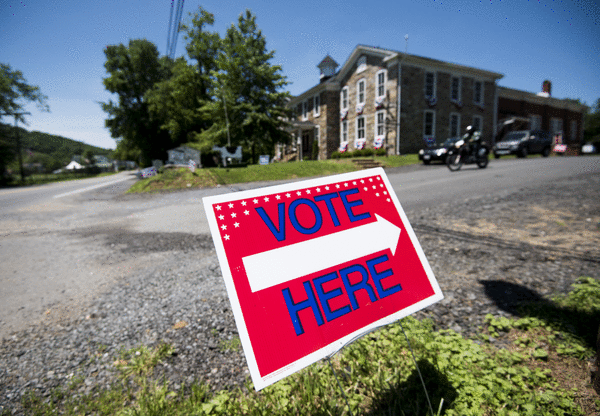
Virginia voters will head to the polls on Tuesday to decide on a Democratic gerrymandering plan that could flip four Republican-held seats in the House of Representatives as the coast-to-coast redistricting war started by President Donald Trump nears the finish line with no clear winner ahead of the pivotal midterm elections.
Polls and pundits believe Democrats are modestly favored to win the statewide referendum that is aimed at rejiggering district lines to transform the blue-trending state’s delegation from a 6-5 Democratic edge to a likely 10-1 juggernaut.
Ascendant Democrats, who swept to victory in the Virginia’s 2025 off-year legislative and gubernatorial elections, frame the move as a necessary step to push back against Trump’s unprecedented effort to rejigger maps in Texas and other red states.
Virginia’s proposed new map, which would still need to be approved by the state’s top court, spreads out the growing advantage Democrats hold in fast-growing suburbs of Washington, D.C. and Richmond and college towns to effectively swamp GOP-leaning rural regions.
The referendum is one of the last major chess moves in the state-by-state partisan fight with Florida Republicans considering grabbing anywhere from two to five seats Democratic-held seats in a special legislative session later in April.
Some nervous Sunshine State Republicans are urging Gov. Ron DeSantis to stick with the current map or only implement minor changes because Democrats have dramatically overperformed expectations in recent elections, spreading fear that new maps could backfire by endangering GOP incumbents.
As the final pieces fall into place, the great 2026 redistricting war appears to be heading to a virtual stalemate that won’t prevent Democrats from being in the political driver’s seat to flip the House in the November election.
Trump unleashed the redistricting fight by ordering Texas Republicans to redraw the maps in the biggest red state to pick up as many as five Democratic seats. The map they jammed through now looks more likely to add just three seats because two moderate Democrats in South Texas seem likely to hang onto their seats despite the new map.
Other Republican states followed Texas’ lead. New maps in North Carolina, Ohio and Missouri are considered likely to result in pickups of one seat for the GOP in each state.
California hit back hard by reworking its districts to flip five GOP seats in the deep-blue Golden State. A statewide referendum easily rubber stamped the move, which is expected to result in a 48-4 Democratic edge in the state.
Democrats are almost certain to pick up a single extra seat in deep-blue Utah, which was forced to create a heavily Democratic Salt Lake City-based district to comply with a fair-districts amendment to its state constitution.
But other redistricting efforts fell flat in red states like Indiana and blue ones like Maryland and Illinois. Incumbent lawmakers in both parties have pushed back against abrupt shifts that could dramatically change the political landscapes within each party and potentially force incumbents into messy primaries with rivals.
Meanwhile, Democrats’ effort to flip a Republican-held seat in New York City failed when the conservative Supreme Court stepped in and blocked an order to redraw Rep. Nicole Malliotakis’ Staten Island-based district to include more racial minorities.
One of the biggest potential shifts in the redistricting war could soon come from the Supreme Court, but it’s likely too late to have much if any effect on 2026.
The conservative top court is expected to rule this spring on whether to strike down much of the federal Voting Rights Act, the landmark civil rights law that opened the door to Black congressional representation in the Deep South.
If the justices rule against voting rights, it would permit white Republican-run states to eliminate up to a dozen Democratic-held seats now represented by Black lawmakers.
But the decision appears to be coming too late in the election cycle for changes to take place in time for the midterms because many of the states have already started their primary processes using the old district lines.
©2026 New York Daily News. Visit nydailynews.com. Distributed by Tribune Content Agency, LLC.






Comments