Florida 2026 childhood vaccination rates fall, even as measles cases hit record levels
Published in News & Features
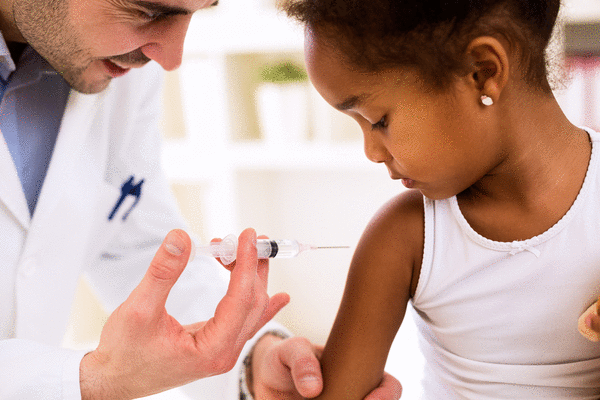
FORT LAUDERDALE, Fla. — Florida’s childhood vaccination rates continued to drop in the 2025-26 school year, even as measles cases in the state soared in 2026.
The vaccination rate for Florida kindergartners now hovers around 88% for the second school year in a row, after having been well above 90% in the decade before the pandemic, according to newly released Florida Department of Health data. In 2016, the rate had been as high as 94%.
Immunization levels for seventh-graders in Florida dropped from 92.1% last school year to 91.9% in the 2025-26 school year, the lowest level in more than a decade. Those levels are well below what is considered adequate for herd immunity, which typically requires a vaccination rate of 95% to prevent the spread of highly contagious diseases. Herd immunity protects those who are immunocompromised or can’t get vaccinated for health reasons.
“This means that fewer children are protected against vaccine-preventable illnesses, which not only puts them at risk of being ill with things like measles, whooping cough, and other diseases, but also puts the people around them at risk,” said Dr. Jennifer Takagishi, vice president of the Florida Chapter of the American Academy of Pediatrics. “One child who gets the measles exposes 12 people.”
In South Florida, childhood vaccination rates reflect a decline in public health confidence and an increase in vaccine hesitancy. Kindergartners in Florida are required to be immunized against certain contagious diseases, but there has been a trend toward more parents obtaining medical and religious exemptions for their children. Several online groups and vaccine opposition organizations have formed to advocate for parental choice and a more cautious approach.
Takagishi says pediatricians across the state are seeing more parents who refuse to have their young children vaccinated. “This has been simmering out there for a long time, but it has definitely increased significantly since COVID,” she said. “The key messages are that the vaccines are safe, they’re effective, and they are keeping our children, our families, and children who cannot get vaccinated safe. That is really what our goal as pediatricians is.”
Newly released data shows Broward County’s kindergarten immunization rates for the 2025-26 school year, 84.7%, is the lowest in the state and well below the state average. Palm Beach County reported a slightly higher rate of 88% for kindergartners and Miami-Dade reported 90.8%. County immunization rates include students at public and private schools.
Public health officials focus on vaccination rates among kindergartners because elementary schools can be hot spots for germs and the source of community spread. By kindergarten, children must be vaccinated against diseases including measles, mumps, rubella, polio, chickenpox, and Hepatitis B.
The immunization rates factor in an ongoing drop in student enrollment in all three South Florida counties. Across Florida, the number of children enrolled in home education has increased by 46% since 2020, according to the Florida Department of Education. However, the state calculates vaccination rates as a percentage of the total number of students enrolled, so the enrollment decline is factored in.
In addition to kindergarten, students are required to have additional vaccines by seventh grade. In South Florida, only Palm Beach County reported higher immunization rates for seventh-graders than the state average. Broward County reported a 90% immunization rate for seventh-graders, Palm Beach County 93.6%, and Miami-Dade 90.2%.
Seven months ago, Florida Surgeon General Dr. Joseph Ladapo publicly decried childhood vaccine mandates as “wrong” and positioned Florida as the first state in the nation that would make vaccines totally optional. However, a bill to remove some vaccine requirements that appeared in this year’s legislative session failed to advance. Gov. Ron DeSantis criticized the House for failing to pass the bill, dubbed the Medical Freedom Act.
Major medical groups and pediatricians spoke in favor of routine immunization, and the Florida chapter of the American Academy of Pediatrics lobbied legislators against lifting vaccine mandates, warning that reducing vaccination requirements could risk outbreaks of preventable diseases, particularly in a high-tourism state. Florida pediatricians, however, acknowledge that there are parents who cannot be convinced to vaccinate their young children.
Under Florida law, the most critical vaccines are “locked” into state statutes, meaning the Department of Health cannot change them without a vote from the House and Senate.
Still, the Department of Health is advancing a plan to remove four vaccines from state rules, which it can do unilaterally. The vaccines the state no longer plans to mandate are varicella (chickenpox), Hepatitis B, Haemophilus influenzae type b (Hib), and Pneumococcal conjugate (PCV15/20). State law still would require vaccines for polio, measles, mumps, rubella, diphtheria, pertussis and tetanus.
Currently, children in Florida cannot attend school without proof of required immunizations, unless they have an exemption. Florida’s nonmedical exemption rate among kindergartners — about 4.5% — is higher than the U.S. median of 3.4%, according to Johns Hopkins School of Public Health.
So far, 2026 has been a tumultuous year in Florida for vaccine-preventable diseases:
The nationwide measles outbreak reached the Sunshine State, with cases reported in 13 counties. According to data from the Department of Health, 144 measles cases have been reported in the state as of April 4. Florida now ranks fourth in the country for the most measles cases in 2026, behind Texas, Utah, and South Carolina. Nationwide, 92% of cases in 2026 have occurred in unvaccinated individuals.
“Vaccines changed the face of American medicine,” said Dr. Paul Robinson, a pediatrician and past president of FCAAP, who spoke out against weakening vaccine protection. “They have held these diseases at bay. But that progress is fragile. When immunization rates drop, the diseases return — we are seeing it now.”
Along with measles, pertussis has also been surging in the state, reaching a five-year high in 2025 with 1,454 cases, more than double the 715 cases reported in Florida in 2024. So far, in 2026, the case count is at 183. There have also already been five cases of mumps in 2026.
“The American Academy of Pediatrics has a lot of great information out there for families who want to read more, Takagishi said. “You can be as healthy as you want and that’s fantastic, but that’s not going to protect you completely from diseases that are preventable. And even if you don’t die from it, maybe there’s someone around you who you expose that does die.”
--------------
©2026 South Florida Sun Sentinel. Visit at sun-sentinel.com. Distributed by Tribune Content Agency, LLC.





Comments