Testimony in Miami trial details final hours before Haiti president was killed
Published in News & Features
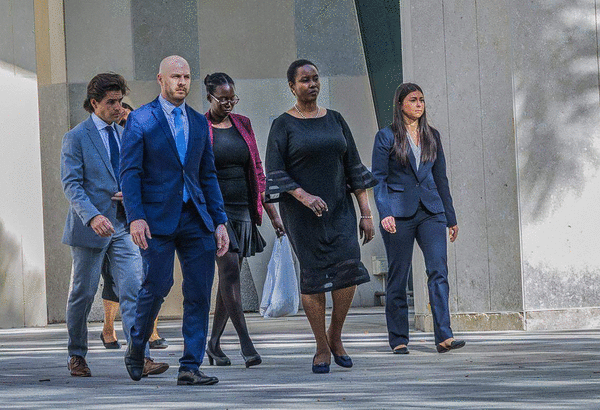
MIAMI — The six Colombians commandos stood in front of a pickup truck in the brightly lit courtyard of the sprawling home in the hills above Port-au-Prince.
James Solages, a Haitian-American handyman who had been portraying himself as an Iraqi war veteran and paid employee for multiple U.S. government agencies, stepped forward and began speaking in English as a leader of one of the former Colombian soldiers translated into Spanish.
Nearby, former Haiti senator Joseph Joël John leaned over a wall, straining to follow the conversation with his limited understanding of both languages.
John, who had just had a tense exchange with Solages over a plan to remove Haitian President Jovenel Moïse from power, watched as a circle formed around Solages. Among those gathered were Joseph Vincent, a former U.S. Drug Enforcement Administration informant; Joseph Félix Badio, who claimed he worked for the Department of Homeland Security; and Rodolphe “Dodof” Jaar, a onetime DEA informant who owned the home where the group met that summer night more than four years ago.
The circle, John told a federal jury in Miami this week, expanded to 10 people as Solages broke the huddle and ordered what he called “the special commando” team into the pickup to carry out the plan to kill the president at his nearby residence.
“The person who was calling the shots was James Solages,” John, 55, testified Thursday. “He took his position as the boss. He excluded me from two meetings he was having so that I wouldn’t oppose the assassination of Jovenel Moïse.”
Solages’ lawyer, Jonathan Friedman, challenged John’s insistence that his client was responsible for the assassination. He accused him of “speculating” and “saying anything to please the government in this trial to point the finger at Mr. Solages.”
“You will say anything in front of this jury to get a reduction of your sentence?” Friedman said to which John responded: “I did not come to accuse anyone. I came to tell the truth.”
In December 2023, John received a life sentence in the U.S. case after pleading guilty to knowingly conspiring to provide material support to assassinate Moïse, who was killed on July 7, 2021; providing that support himself, and knowingly conspiring to murder a person outside the United States.
First government cooperating witness
John is the first of six government cooperating witnesses to testify at the trial of four South Florida men charged with conspiring to kidnap and kill Haiti’s president. He is hoping to gain a reduced sentence in exchange for his testimony on behalf of the government.
Over three-and-a-half days on the stand, John described the events leading up to the president’s assassination, when Moïse was shot a dozen times inside his bedroom and his wife, Martine, was seriously wounded. John also provided insights into some of the central figures and critical turning points in the plan, including a Doral-area firm, Counter Terrorist Unit Security, which allegedly hired the former Colombian soldiers and promised the assistance of airplanes, weapons and “5,500 agents” to dislodge Moïse along with the aid of armed gangs and a rogue police group.
John, who ended up fleeing Haiti for Jamaica in August 2021 after the brazen slaying, wrapped up his testimony for the government detailing the hours before a convoy of the Colombians, Haiti national policemen along with Solages, Vincent and Badio stormed the president’s Pèlerin 5 neighborhood in the middle of the night. His testimony offered one of the clearest descriptions yet of a pivotal moment in the plot — how it began as an effort to remove Moïse from power and turned into an assassination that plunged Haiti deeper into gang-fueled terror and despair.
Plot hijacked?
On trial are Solages, a CTU employee who served as a conduit with the Haitians; Arcángel Pretel Ortiz, a Colombian national and former FBI informant; Antonio “Tony” Intriago, the Venezuelan American owner of CTU along with Pretel, who ran CTU Federal Academy, and Walter Veintemilla, an Ecuadorian American accused of helping finance the plan. A fifth defendant, Christian Emmanuel Sanon, a Haiti-born pastor and doctor who had sought to replace Moïse as president, will be tried separately because of health issues.
Under cross-examination, the defense sought to undermine John’s credibility, pointing to statements he made to the FBI after his arrest in Jamaica in January 2022.
“You said to an FBI agent, CTU did not assassinate president Jovenel Moïse,” defense attorney David Howard said. “You said that, and it’s not a lie, is it?”
John, also known as John Joël Joseph, had met with prosecutors 31 times to prepare for his testimony, and Howard argued that his story kept changing. John denied he had changed his account multiple times — though he acknowledged that he had initially withheld information out of fear for his life, and insisted that now he is telling the truth.
Howard also pressed a key defense argument: The plan to arrest Moïse, using a warrant signed by a Haitian judge, was hijacked by members of the presidential security detail and Haitian national police, resulting in the president having been killed by the time the convoy of Colombian commandos arrived at his home.
Central to that defense is Badio, who according to John’s testimony suggested that they cut up Moïse’s body, put it in a barrel and dump it in the ocean.
Badio, it was revealed during trial, also paid for rental vehicles and procured DEA patches and diplomatic license plates to make the scheme falsely appear like a U.S. government-sanctioned operation.
Though he has not been charged in the United States, Badio has also been mentioned by prosecutors. A lawyer, he was fired from his job in the Haitian government’s anti-corruption unit in May 2021. He first met John a month earlier, after the former Haitian lawmaker and security company owner returned from a trip to South Florida, where he had spent three days meeting with all four of the defendants, as well as Sanon and others.
Badio let it be known he was aware of the CTU visit and he “could not” support Sanon as president, according to John.
Badio also let it be known that he had his own candidate in mind to replace Moïse, John said. Badio told him that he had 100 members of the General Security Unit of the National Palace ready to stand down after bribing them with $1,000 each to secure the palace once Moïse lost power to ensure that his choice, Superior Court Judge Windelle Coq Thélot, took over the presidency without interference. Also aligned with Badio, John said: the unit’s police commander, Dimitri Hérard.
“After April 11, for the six-week period that you were meeting approximately twice a week [with Badio], did CTU ever come up in your discussions with Badio?” Howard asked John.
John responded that he spoke with Badio about the company’s pledge to bring investors into Haiti and provide security for the country, including training for the police and armed forces, once Sanon became president.
John acknowledged that Badio and his team — including Reynaldo Corvington, whose security company’s ammunition has been linked to the plot by Haitian police, and former police commissioner Gilbert Dragon, who died in prison after his arrest in the assassination — were trying to convince him to drop the idea of Sanon as president in favor of Coq Thélot.
But despite Badio’s behind-the-scenes plotting, John insisted that the former official was not the one in charge of the operation.
“Badio was not the commander of the Colombian commandos in Haiti,” John testified. “James Solages... was.”
John, who said Moise had provided weapons to gangs and used them to terrorize the population, found his own role under scrutiny as he repeatedly tried to place blame on Solages and CTU. Intriago’s lawyer noted that he was harbored by a gang leader known as Vitelhomme before escaping by boat to Jamaica with one of the Colombian commandos, and he had tried to acquire weapons to oust Moïse.
“We acted illegally against a power that was in place illegally,” John said in response to questions.
Multiple plans
During his testimony, John said that there had been various schemes to “capture” Moïse, among them a massive demonstration planned by Sanon.
“He said he was going to organize the demonstration with the Protestants and for the Protestants to go into the National Palace and kill” Moise, John said about Sanon, adding that he was shocked by the endorsement of murder.
Weeks later, John said, Solages called him up with a new plan. This one involved drugging the president while he visited his sister’s house in the Delmas 75 neighborhood of the capital and then getting him to sign a resignation letter.
Solages claimed that someone named Alex “was going to bring a drug, they would give the drug to the president and the president would lose all his consciousness, and then they would ask him to sign the resignation letter,” John testified. John said he was asked to provide a truck to carry the corpses of the president’s security detail in case any died in the plot.
“I told them I do not have a truck, nor do I have the means to get one,” John said about the early June 2021 plan.
That plan also went nowhere along with two others before July 7, one on July 19 and another the evening of June 26 and 27th.
The government described the July 19 plan as “the first real attempt” to kidnap Moïse.
“I called CTU for the materials, I asked how much money they are going to give and at the end they couldn’t give anything,” John testified about the plan to “capture and exile” the president when he returned from an overseas trip from Turkey on June 19, 2021. “CTU promised to purchase weapons ...and send them to me via a helicopter from the Dominican Republic.”
Turning point
The turning point came on June 8, 2021, John said, the day after he visited Sanon at home in Port-au-Prince. He saw Sanon was being guarded by eight heavily armed men he later learned were Colombians.
Sanon was already acting as if he were president, John testified.
John went home, he said, and spent the whole night thinking about supporting Coq Thélot. The next day, he summoned Vincent and Solages and laid out his grievances against Sanon.
“I said you’re going to have a lot of problems, a lot of protests against you and the political crisis is going to be worse than what it is now under Jovenel,” John said. “I told them the best choice you can make now is Judge Windelle Coq Thélot.”
Sanon wasn’t open to advice and his behavior, even before taking power, indicated that “he would be worse than Jovenel,” John said.
There was something else that worried him about Sanon, John testified: “Sanon stated that he wanted to be president of the transition for five years. And while he’s president for five years, he would organize elections ... and he would stay on for a total of 10 years.”
A shift in the plot
On the night of July 6, 2021, John arrived at Jaar’s house at 7:45 p.m. Badio came an hour later, and Solages and Vincent, who has also pleaded guilty in the Miami case, arrived around 11 p.m.
The Colombians, John said, were in the courtyard cleaning their weapons and ammunition and Jaar was inside.
He watched helplessly, John testified, as the team of Colombian commandos, Solages and Vincent prepared to leave Jaar’s home.
One Colombian climbed in behind the wheel. Another took the passenger seat. Three more jumped into the back seat, before a final man squeezed in between them.
Before leaving, John said, Solages turned to him and asked, “Where are the people you brought to clean?”
“I said, ‘I did not have that understanding with you tonight,’” John testified. Still in shock over the switch in plans, he said, he replied: “You’re going to kill Jovenel, and you’re going to set his house on fire, and now you’re asking for people to come and clean — to clean what?”
Earlier that night, he said, Vincent told him the plan had changed to “kill and burn” the president and his wife — a stark departure from the plan to remove Moïse from power.
“I was shocked, and I said, ‘Why kill the president?’ ” John said. “They didn’t answer.”
Then Solages spoke. “One entry, one exit,” he said, according to John.
“What did you take that to mean?” Assistant U.S. Attorney Sean McLaughlin asked.
“I interpreted it that they would go in, kill the president, and that would be the end of it,” said John, who wept at times during his testimony. “My position was for Jovenel leaving power, to be exiled, not killed.”
The night of the killing
After the disagreement about the plan to kill Moïse, Solages took John’s vehicle and driver, leaving him briefly stranded, the former lawmaker testified.
As he made his way down the mountain, John said, he received a call from his driver reporting heavy gunfire at the president’s residence.
He called Solages and urged him to leave.
“Let me do my job,” he said Solages replied.
In later calls, John testified, Solages told him that the president was dead.
“Upon learning the president is dead, where did you go?” prosecutor McLaughlin asked.
“A guesthouse,” John replied. “I didn’t feel safe to go home because I was not expecting the president to die.”
He said there was no contingency plan for Moïse’s death and that he warned against any immediate attempt to install a successor at the National Palace.
“The first thing that James Solages asked me was to ensure that Madame Coq go to the National Palace,” John said. “I answered him that anyone who sets foot inside the palace” would be blamed for the death of Moïse.
He relayed the same message, he said, when Sanon called, telling him that “the guys” had asked him to head to the palace.
John said he also rejected requests from Solages to mobilize people in the streets in the early hours after the killing, saying he responded: “Under what authority am I going to ask the people to take to the streets?”
©2026 Miami Herald. Visit at miamiherald.com. Distributed by Tribune Content Agency, LLC.




Comments