Judge temporarily bars government from revoking work authorization of former Illinois cop arrested by ICE
Published in News & Features
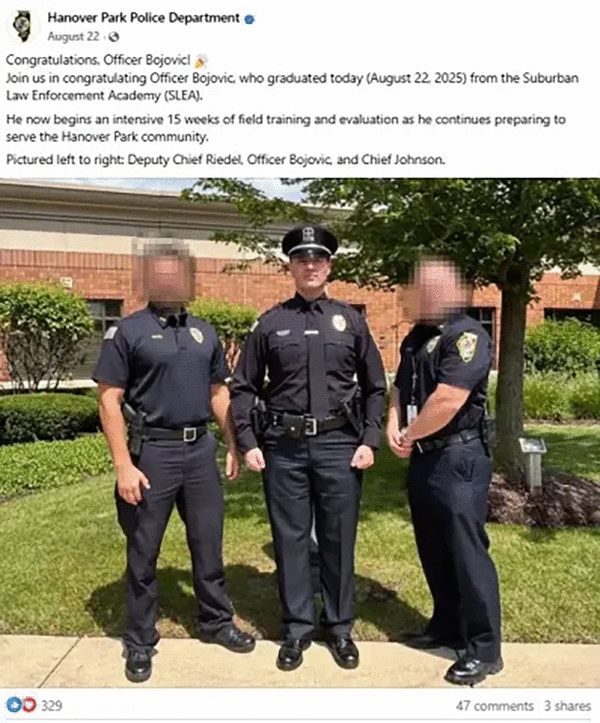
CHICAGO — Amid the Trump administration’s 64-day local mass deportation campaign in October, U.S. Customs and Immigration Enforcement officers arrested then-Hanover Park police Officer Radule Bojovic for allegedly overstaying a tourist visa. His department, in turn, placed the Montenegro native on administrative leave.
Now, a federal judge has ruled that at least for the time being, the government cannot deny Bojovic his ability to work — after he was ultimately left jobless amid the government’s efforts to do just that.
U.S. District Judge Jorge Alonso last week ruled the government is temporarily barred from revoking Bojovic’s employment authorization, effective for 14 days.
The Wednesday order came after the government revoked Bojovic’s work permit in January, and after he was subsequently let go from the Hanover Park Police Department, village officials confirmed to the Chicago Tribune.
Bojovic “is a public servant who has not been shown to present any threat to the community (quite the opposite, if anything), and the Court fails to see what the government gains by suspending his employment without pay based on what appears likely to be, so far as the parties have shown as this early stage, a legal and/or factual error,” Alonso wrote in his Tuesday order.
Bojovic’s arrest was widely publicized, garnering attention from news outlets across the country. In November, as Operation Midway Blitz wound down and President Donald Trump directed his immigration crackdown elsewhere, Bojovic was released from ICE custody on bond. Meanwhile, Bojovic returned to full duty, with village officials maintaining he retained a valid permit to work in the country while he awaited the outcome of his immigration proceedings.
Shortly after, Bojovic received a “notice of intent to revoke” his work permit from U.S. Citizenship and Immigration Services, court filings show.
USCIS, in its Dec. 11 notice, told Bojovic he was wasn’t eligible for a work permit because the immigration policy that had previously granted him authorization no longer applied to him.
Bojovic, per court filings, immigrated to the United States from Montenegro, a small country in southeast Europe, with his family in 2014 on visitor visas. His father subsequently applied for asylum in 2016.
Bojovic, who was 16 years old at the time, was included in that application as a “derivative child,” court records say. Immigration law defines a child as anyone who is under 21 years old and unmarried.
Under his father’s application, Bojovic applied for and was granted work authorization several times. He has continued to do so even after turning 21 due to safeguards allotted under the Child Status Protection Act, a 2002 law devised to keep minors from aging out of applications amid USCIS backlogs, according to immigration defense attorney Shelby Vcelka.
CSPA essentially freezes a child’s age on the date their parent files for asylum. That eligibility goes away if the derivative asylee withdraws their application, marries or the principal applicant asylum dies, according to court documents citing a USCIS Affirmative Asylum Procedures Manual updated last year
Most recently, USCIS renewed Bojovic’s work authorization on Sept. 23, 2025, extending his permit through the fall of 2030.
Twenty-two days later, Bojovic was arrested by ICE.
The Department of Homeland Security accused Bojovic of overstaying a B2 tourist visa that expired in 2015. Then-DHS spokesperson Tricia McLaughlin — who has since left the agency after a tumultuous year — claimed after the arrest that Bojovic “violated our nation’s law” and had been living in the U.S. illegally for a decade.
“(What) kind of police department gives criminal illegal aliens badges and guns?” McLaughlin had said in a statement.
Background checks in Bojovic by both Illinois State Police and the FBI yielded no criminal history, per Hanover Park police. According to an employment application Bojovic submitted to the village in June 2024 obtained by the Tribune through a public records request, he attended high school in Chicago and previously worked at a church as a janitor and at Ross.
In response to an application question asking why he wanted to become a Hanover Park police officer, Bojovic wrote: “I’m motivated by a strong desire to serve and protect the community. I’m drawn to the opportunity to make a meaningful difference in people’s lives, ensuring safety and fostering trust.”
When Bojovic returned to full duty, McLaughlin in a statement at the time maintained DHS would be “pursuing every legal option available to us, including criminal charges.”
USCIS in its Dec. 11 notice stated that Bojovic didn’t qualify for work authorization anymore because he had been removed from his father’s asylum application on Dec. 3. The agency advised that it wouldn’t be making a final decision for 15 days and that, over those two weeks, Bojovic could submit evidence to refute the revocation.
Bojovic, through his attorney’s office, submitted a letter to USCIS dated Dec. 22 maintaining he was still on his father’s pending application. His attorney’s office denied comment for this story.
On Jan. 23, USCIS sent Bojovic a formal revocation notice. Two weeks later, Bojovic filed a civil complaint against Homeland Security Secretary Kristi Noem — who President Donald Trump has since announced he’d be replacing — and USCIS Director Joseph Edlow.
The Feb. 6 complaint argues the revocation was “arbitrary, capricious, and not in accordance with the law.” It states that the government’s decision was an abuse of discretion and implores that Bojovic’s work authorization be reinstated.
Losing his permit, the complaint says, has rendered Bojovic unable to “continue his service as a police officer.”
A Hanover Park police spokesperson, in a written statement to the Tribune, said that after the village received notice of the revocation, Bojovic “was separated from employment.” As of Friday, he was not employed with the village, the spokesperson said, who declined any further comment.
Bojovic’s October arrest changed the “whole posture” of his case overnight, said Vcelka, the immigration attorney.
“You’re living your life, you’re working, you’re thinking, ‘Oh, my parent’s application is processing the way it should’ ... and all of a sudden, you get picked up and arrested by ICE,” she said, “and now you’re in deportation proceedings.”
In a subsequent filing seeking a temporary restraining order and preliminary injunction, plaintiff attorneys suggest “apparent political reasons” are behind the government’s actions. The filing also states that Bojovic “faces imminent and catastrophic hardship” without the ability to work or receive employer-sponsored health care.
In response, defense attorneys for the government recognized Bojovic had recently been renewed to work but stated that because he was placed into removal proceedings after his arrest, the agency moved to revoke. They also maintain that the litigation “undermines the review scheme that Congress laid out for asylum,” saying USCIS’s denial was an early step in a larger appraisal process over Bojovic’s asylum claim and that it should be understood as a tentative recommendation rather than final.
To that end, on March 3 USCIS “reopened” Bojovic’s work authorization application, defense attorneys note.
As far as the impact losing his ability to work has had and stands to have on Bojovic, defense attorneys argue economic losses are not sufficient to show irreparable harm and maintain any impact to his reputation or health care is “entirely speculative.”
Alonso, in his temporary restraining order, called defendants “shockingly cavalier” in their estimation of harm done. He also states that defendants failed to defend USCIS’s decision to revoke on its own terms.
“That silence speaks volume,” Alonso wrote.
Alongside barring revocation, Alonso also ruled the government couldn’t take any steps to remove Bojovic from his parent’s asylum application.
The case is due for a status hearing on March 31, when Alonso’s order expires.
_____
©2026 Chicago Tribune. Visit chicagotribune.com. Distributed by Tribune Content Agency, LLC.






Comments