Trump's delay of Xi visit echoes pattern of last-minute changes
Published in News & Features
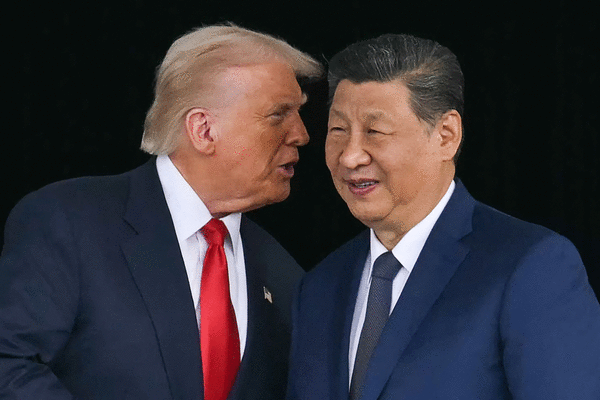
WASHINGTON — President Donald Trump has long used last-minute switches on foreign travel and meetings with heads of state as he seeks to gain a diplomatic upper hand and keep foreign partners on their toes.
Trump’s request this week to delay a planned trip to China initially set for March 31 to April 2 is the latest example in a pattern of postponing or calling off high-profile meetings that he decides don’t suit his interests.
Throughout his first and second terms, he has enjoyed keeping allies and adversaries guessing about his travel plans. A few times, he’s changed his mind about his schedule in real time, often in an effort to display power, send a message to foreign capitals or to avoid embarrassment.
During his first term, Trump canceled a visit to Denmark when that country said Greenland wasn’t for sale, canceled a meeting with Vladimir Putin when the Russian president was already on the way and fueled will-they-won’t-they speculation before a get-together with North Korea’s Kim Jong Un.
The list keeps going.
This time around Trump initially floated a delay to a highly anticipated China summit during a weekend interview. He made the comment as he called on China and other countries to help him counter Iran’s blockage of the Strait of Hormuz since the war with the Islamic Republic began on Feb. 28. Subsequently, his aides were quick to say that Trump was not putting the meeting on ice to try to squeeze Chinese President Xi Jinping to help the U.S. reopen the strait — a request few nations have heeded.
Then on Monday, Trump said he had to stay in the U.S. because of the war.
“I want to be here. I have to be here, I feel. And so we requested that we delayed a month,” he said. “It’s very simple. We got a war going on. I think it’s important that I be here.”
White House Press Secretary Karoline Leavitt earlier in the day told Fox News that the meeting wasn’t “in jeopardy, but it’s quite possible the meeting could be delayed.”
“It’s really just a matter of the timing,” she added.
China’s view
Stakes for the summit were high after the U.S. and China engaged in a trade war for much of last year. A delay could end up being a boon for China, which had requested a later date to allow more time for officials from both countries to work out details before the two leaders meet face-to-face.
China is willing to delay the summit given the already short preparation period and that uncertainty about the Iran war could create embarrassing moments, according to a person familiar with the matter.
China is still open to proceeding and there hasn’t yet been any formal communication from the U.S. requesting a delay, said another person, who requested anonymity to discuss private talks. Logistical planning is continuing despite lack of clarity about when the event will occur, the person added.
When asked on Tuesday to confirm or comment on the suggested postponement, Lin Jian, a spokesperson for the Ministry of Foreign Affairs in Beijing, only said that China and the U.S. “are maintaining communication regarding issues such as the timing of President Trump’s visit to China.”
A number of factors for the postponement could be at play — Trump increasingly eschews travel and prefers world leaders come and pay tribute to him at the White House or at his Palm Beach estate. The American president, a former reality television star, enjoys keeping allies and adversaries alike in suspense about big decisions. And he is now consumed with a war he predicted would be a swift victory, with no clear end in sight and few nations prepared to join him in pursuing it.
Still for Trump, teasing a schedule change is part of a well-worn playbook. Much like he threatens — and sometimes reverses declarations — to levy tariffs or to exit international treaties, Trump sees his foreign visits as another way to barter with other countries.
“He delights in mixed messages,” said Republican strategist Matthew Bartlett, who added it remains unclear how much influence Trump truly has over China. “Leverage is a beautiful thing when you have and a brutal thing when you think you have it and and don’t,” he said.
Historical patterns
This isn’t even the first time Trump has publicly wavered on a meeting with Xi. Last fall before the two were scheduled to sit down at an international summit, he told reporters that “maybe it won’t happen.” Ultimately, that session did occur.
Sometimes Trump dangles a cancellation but does not follow through.
He memorably canceled a planned 2018 summit with North Korea’s Kim in Singapore amid pique over some fiery rhetoric from Pyongyang.
In a letter, the U.S. president called it a “truly sad moment in history.” Yet he soon softened after a conciliatory statement from North Korea and the meeting was back on. Though the summit yielded no diplomatic breakthrough, he presented it a great success.
At other times, Trump cancels and holds firm, perhaps to avoid a meeting he thinks may be a problem or an embarrassment later.
There was a planned visit to Denmark in 2019, which he said he would not do because the prime minister had “no interest in discussing the purchase of Greenland.” He also canceled a meeting with Putin at the 2018 Group of 20 meeting — when Putin was already en route — over Russia’s decision to fire on Ukrainian ships.
Trump scrapped plans in 2018 to travel to London for the opening of a new U.S. embassy, saying he did not like the location. But by doing so, he avoided coming in contact with potential protests.
Early exits
At other moments, Trump has exited foreign engagements early, to enact pressure or express frustration.
Just last year, he left a meeting of the Group of Seven major economies in Canada ahead of schedule. Before that, in 2018 at another G-7 in Canada, Trump backed out of a joint communique after clashing with then Canadian Prime Minister Justin Trudeau and departed earlier than planned. He did it again in 2019, when he scrapped a press conference at the end of a NATO summit. That came after another a group of world leaders were caught on video mocking Trump.
And in some moments, Trump has also deputized others to travel in his place, declining some trips at last minute.
In 2018, he canceled a trip to South America, citing a crisis in Syria, and sent Vice President Mike Pence. Again in 2019, Trump sent Pence to Poland for an event commemorating the 80th anniversary of the start of World War II, opting to stay in the U.S., where he furiously monitored a hurricane in real time — sending out tweets and videos and at one point showing off a doctored map that did not match the projected path of the storm.
Last year, Trump declined to attend the Group of 20 nations in South Africa and initially said he would send Vice President JD Vance instead, but then decided to have no representation at all.
Critics see these tactics as Trump imposing more chaos on the world stage. But he loves to keep everyone guessing by being predictably unpredictable.
By weaponizing access, Trump underscores the value he places in person-to-person meetings. A self-branded dealmaker, he sees a meeting with the U.S. president as a prize unto itself and has frequently teased other countries over trips and meetings throughout his first and second terms. Rarely do his get-togethers have the kind of extensive preparation that typically goes into such an event — or the same type of prearranged outcomes.
_____
(With assistance from John Harney, Eric Martin and Colum Murphy.)
_____
©2026 Bloomberg L.P. Visit bloomberg.com. Distributed by Tribune Content Agency, LLC.






Comments