US allies wary of joining Trump's Strait of Hormuz mission
Published in News & Features
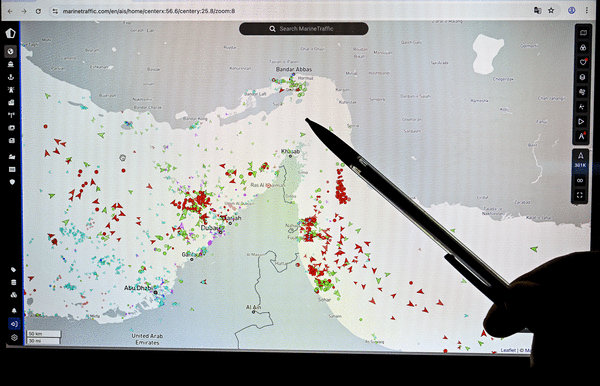
U.S. allies deflected President Donald Trump’s demands to help reopen the Strait of Hormuz, expressing unease about getting pulled into the war in Iran.
In Brussels, European Union foreign ministers stressed that they did not want to escalate the war, treading cautiously about even redirecting an existing Red Sea naval mission to the vital passage for energy shipments. In Japan, officials said there were no plans to dispatch ships to escort stalled tankers. The U.K. similarly wouldn’t commit to a full naval mission, even as Prime Minister Keir Starmer said he’d explore options with allies.
“We will not be drawn into the wider war,” Starmer said Monday during a press conference in London. “Ultimately we have to open the Strait of Hormuz. That is not a simple task.”
Luxembourg’s Foreign Minister Xavier Bettel was more blunt: “Blackmail is not what I wish for.”
The responses amounted to a rebuttal of Trump, who on Sunday insisted that his allies in NATO and Asia help get oil and gas shipments moving through the Strait of Hormuz, which has been effectively closed since the U.S. and Israel attacked Iran. Roughly one fifth of the world’s oil moves through the narrow passage.
The blockade has sent energy prices soaring, leaving governments worried about inflation, economic slowdowns and even food supply disruptions. But on Monday, officials were also cautious about aiding Trump’s operations, which have prompted Tehran to spray missiles and drones across the region.
“We must not do anything that adds even more tension or escalation,” Spanish Foreign Minister Jose Manuel Albares said in Brussels. “What we need is for the bombings and the missile launches against all countries in the Middle East to stop, and for us to return to the negotiating table.”
Trump directly called out his North Atlantic Treaty Organization allies in an interview with the Financial Times, warning that the military alliance would have a “very bad future” if its members don’t aid the U.S. in Iran. The president’s renewed attacks on the transatlantic organization received a tepid response from European officials on Monday.
“I don’t see that NATO has decided anything in this direction or could be made responsible for the Strait of Hormuz,” said German Foreign Minister Johann Wadephul, speaking before an E.U. foreign ministers’ meeting in Brussels.
Bettel cautioned that NATO is there to react when members are attacked, not for all defensive or military requests.
“I want to remind that none of us has been directly attacked,” he said. “There are no grounds for now to invoke Article 5,” he added, referencing the alliance’s collective defense clause.
Some were still willing to at least hear Trump out if he presents NATO with a plan.
“We have to look into it and consider it,” Lithuanian Foreign Minister Kestutis Budrys told Bloomberg TV in an interview in Brussels. “I would look for the in-depth debate within NATO.”
Polish Foreign Minister Radoslaw Sikorski agreed: “If there is a request with NATO to discuss the issue, we will of course consider it out of respect and sympathy for our allies.”
The U.K. is also exploring whether it could help by deploying autonomous mine-hunting drones alongside other U.S. allies, according to people familiar with the matter, even as it has no plans to joint a full naval mission to secure the Strait while the war is ongoing.
“We are working with all of our allies including our European partners to bring together a viable collective plan that can restore freedom of navigation in the region as quickly as possible,” Starmer said. However, he warned that deploying naval assets was “not easy” and “not straight-forward.”
A NATO official told Bloomberg that allies have already offered more security for the Mediterranean, adding that individual allies were talking with the U.S. and others about what else they could do, including for the Strait of Hormuz.
E.U. foreign policy chief Kaja Kallas was one of the few voices pushing for the bloc to redirect regional resources to the Strait of Hormuz. Specifically, she encouraged member states to consider expanding their Aspides naval mission, which was originally launched in 2024 after the Houthis attacked shipping vessels in the nearby Red Sea.
“If we want to have security in this region, it would be easiest to already use the operation we have in the region and maybe change a bit,” Kallas said.
While the Aspides vessels are currently allowed to navigate in the Strait of Hormuz, their mandate doesn’t enable them to do more than that. E.U. countries would have to unanimously agree to change those directives, which could be difficult.
Germany has already expressed its opposition.
In an interview with ARD on Sunday, Wadephul said he was “very skeptical that expanding the Aspides mission in the Strait of Hormuz would lead to greater security” and that Germany “will not participate in this dispute.”
Italy is similarly not currently in favor of repurposing the Aspides mission to guard the Strait of Hormuz. The country has one ship deployed in the mission.
“The Red Sea mission needs to be strengthened within the Red Sea, but changing it is complicated,” Italian Foreign Minister Antonio Tajani said Monday. “We think that for now, it is right it stays in the Red Sea.”
Even if E.U. countries won’t redirect Aspides, they may be willing to commit more assets to the region, an E.U. diplomat said. Already, France has sent two extra vessels to bolster Aspides.
Countries are also exploring a potential “coalition of the willing” operation for the region, Kallas said.
“We also need to see what would be the fastest way to provide this opening of the Strait of Hormuz,” she added.
--------
—With assistance from Max Ramsay, Katharina Rosskopf, Joe Mayes, Oliver Crook and Daniel Basteiro.
©2026 Bloomberg L.P. Visit bloomberg.com. Distributed by Tribune Content Agency, LLC.






Comments