Data center regulation was a hot topic in General Assembly. But many bills fell by the wayside.
Published in News & Features
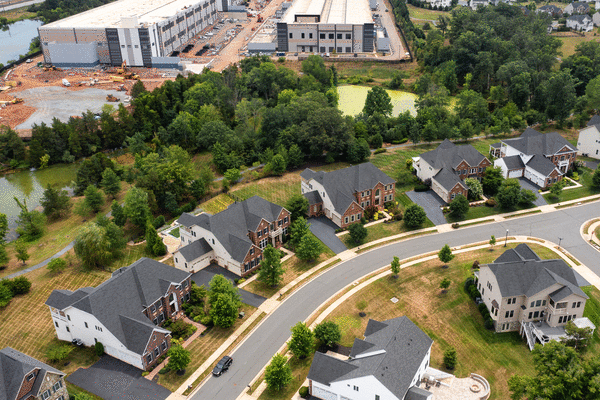
RICHMOND — More than 60 data center-related bills were introduced in the General Assembly this legislative session. About half have been continued to next year or left to languish in committee. Some advocates worry the legislation that does pass this year will not do enough to rein in data center growth they say could strain Virginia’s resources.
“Increasingly, people are starting to understand that the energy infrastructure, the water supply infrastructure, damming rivers, creating new reservoirs, is going to affect 100 times more land than the data center footprint itself, and that’s already a lot,” said Chris Miller, president of the Piedmont Environmental Council.
According to a recent report from the Electric Power Research Institute, Virginia is the only state where data centers consume over 20% of electricity. And that could rise — the institute found that by 2030, data centers could account for between 39% and 57% of Virginia’s electricity consumption.
“We’re talking about tripling of the system and having to make somewhere in the order of $400 to $500 billion of investment, not in data centers, but in the infrastructure to support them,” Miller said. “It’s that extra bit that really has been the focus, and frankly the frustration, is that the General Assembly missed an opportunity to take action this year to get on top of what’s already an out of control increase in demand from the data centers.”
Two bills that would give the State Corporation Commission more regulatory power over data centers appear to have support in the Virginia Senate but have stalled in the House of Delegates.
SB619 would require new high load facilities such as data centers to first seek approval from the SCC and would have to meet requirements like securing sufficient contracts for energy storage or clean electric generating resources, or show they have a plan to implement demand reduction measures. The SCC also would have to take into account whether there’s enough energy, capacity and grid infrastructure to support a new data center and whether its cost would be worth it.
That bill passed out of the Senate on a 23-16 vote with some bipartisan support, but a House subcommittee recommended laying it on the table earlier this week. The House version of the legislation was left in committee last month.
SB339 would require the SCC to study cost allocation of transmission from high-load customers and direct Dominion to determine if the current allocation requires residential customers and others to unreasonably subsidize data center costs. The bill passed out of Senate unanimously, but a House subcommittee recommended continuing it to next year.
“We have two weeks left for the House to realize that this isn’t sufficient, and for the governor to send a strong signal to both houses that she wants to have a more significant package to act on,” Miller said. “There are some good bills that passed, but they don’t address the core problem, which is we’re approving data centers too fast, and the energy that goes with them too, without oversight.”
Gov. Abigail Spanberger did not respond to a request for comment on whether she would like to see additional data center bills cross her desk.
Miller said in the long term, his biggest concern is about water supply. Large data centers can use, by some estimates, 5 million gallons of water a day to cool servers to optimal temperatures. In 2024, the Joint Legislative Audit and Review Commission found Virginia’s data center water use is currently sustainable, but the independent research body found that water use was on the rise and could be better managed. Miller said parts of that report are outdated and there’s not a centralized report of how much water data centers currently use.
“We don’t have enough water for what they’re approving, but nobody seems to be doing the analysis,” he said. “It’s just terrifying that we’re not even asking the question, ‘do we have enough water to meet that demand?'”
HB589, which would have required water utilities to report how much water they were supplying to data centers, died in committee. SB553 would accomplish similar goals and passed out of the Senate. The House introduced a substitute with more lax requirements for proposed data centers to report themselves estimates of how much water they would use on permit applications. Those bills will likely head to a conference committee to work out the differences.
Other data center legislation that advanced this session includes bills that would require public utilities to implement demand flexibility programs for high-energy demand customers, require that data centers meet certain emission standards to receive permits, and direct the Department of Energy to study how to use waste heat from data centers.
Legislators are also weighing whether to end the data center sales and use tax exemption. The Senate’s version of the budget includes nearly $1 billion in revenue from letting that exemption expire at the end of this year; the House version’s does not. Proponents of data centers argue the industry generates significant economic benefits and state and local taxes. The 2024 JLARC report found data centers are responsible for 74,000 jobs in Virginia, amounting to $5.5 billion in labor income and $9.1 billion to Virginia’s economy annually.
The Department of Taxation reports that 90% of data center investment and growth would not have happened without the tax exemption.
The Data Center Coalition says the industry is an economic powerhouse for the state when it comes to investment, job creation and generating tax revenue.
“Throughout this session we have worked in good faith with legislators and stakeholders, and we hope that the outcomes of the session will further our shared goals of responsible operations and economic competitiveness.”
________
©2026 The Virginian-Pilot. Visit at pilotonline.com. Distributed by Tribune Content Agency, LLC.






Comments