Iranian American community divided over Middle East war
Published in News & Features
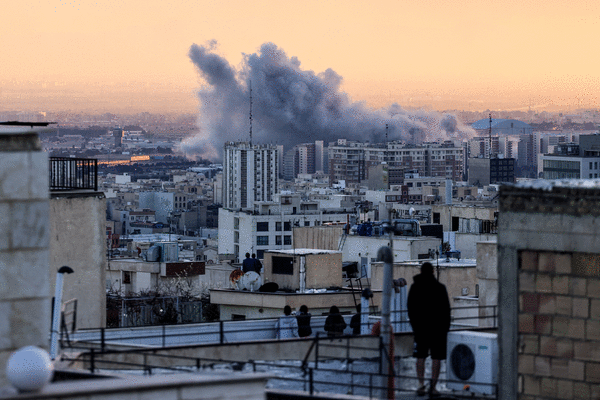
BALTIMORE — As the war in the Middle East intensifies, Iranian Americans in the United States are expressing a wide range of emotions, reflecting deep divisions over Iran’s next leadership and the conflict abroad.
President Donald Trump said Monday that the U.S. has “the capability to go far longer” than its projected four-to-five-week military operation against Iran. Tehran and its allies have retaliated against Israel, neighboring Gulf states, and critical energy infrastructure.
Bethesda, Maryland, resident Hossein Noshirvani, a board member of the Iranian-American Community Center, said the group is divided, when it comes to how members feel about both the bombings and what comes next.
“You know, whether you’re for the Shah or any number of other groups, what is really scary is the amount of mistrust that has been built up in our community,” Noshirvani said. “Everyone is afraid of every other group, and it’s almost like we don’t know how to practice democracy. … We’ve lost our ability to understand democracy. That’s literally the only way I could explain it.”
Noshirvani said decades of instability in Iran have left deep scars.
“It’s hard to explain it to people who who don’t know that,” Noshirvani said. “But when you’re not a part of a stable country for years and years and years, and you’ve just been raised on, ‘Anybody could be a bad person, and if they don’t agree with you, then you’re definitely not a good person’ — that’s going to have some repercussions to the psyche of the community.”
‘A heightened sense of vulnerability’
The tensions abroad have also heightened anxiety among local Muslims. Zainab Chaudry, director of the Maryland office of the Council on American-Islamic Relations (CAIR), said recent aggressions have created “a heightened sense of vulnerability.”
“We are urging vigilance within our communities,” she said, “because it is around these kinds of historical moments where there tends to be an uptick in the number of retaliatory comments and incidents that occur.”
Federal data shows that since the turn of the century, violence against religious communities often spikes in the United States following incidents of international and domestic terrorism, as well as changes in foreign policy.
According to the U.S. Justice Department, crimes against Muslim persons and property have experienced three distinct jolts in figures since 2000.
The first, and most dramatic spike took place in the aftermath of the 9/11 attacks in New York City and northern Virginia. The attacks, coordinated by the pan-Islamist group al-Qaida, killed nearly 3,000 Americans and initiated the country’s decades-long war against terrorism in the Middle East.
FBI data on hate crimes reported an immediate increase in offenses, from four in August 2001 to 377 that September. To that point, since the agency started collecting the data in 1991, the highest number of anti-Islamic offenses in a month was 14.
Over the next decade, the Justice Department investigated hundreds of hate crimes against people “perceived to be of Middle Eastern origin,” ranging from threats over the phone to bombings at places of worship. And the FBI data shows that the monthly totals, generally, have not settled to their pre-2001 rates.
The other two notable spikes took place in February 2017, the second month of President Donald Trump’s first term and the peak of his short-lived Muslim travel ban; as well as in the weeks following Hamas’ Oct. 7, 2023, attacks in Israel, the deadliest in the country’s history.
With the latter, the FBI recorded 18 anti-Islamic hate offenses the month beforehand, 75 the month of the attack and 56 in the month after.
Although Chaudry noted the effects of macro events like elections and warfare on hyperlocal violence, she said rampant underreporting means the FBI’s data still “does not reflect the lived realities and experiences of our communities.”
“There’s a very real sense of mistrust within law enforcement,” she said, “or fear that if they do report, there might be some sort of retaliation or that the incidents won’t be taken seriously.”
Chaudry said CAIR Maryland recorded 341 requests for assistance last year: civil rights complaints that could involve derogatory comments at someone’s job, possible infringements on someone’s free speech or bullying at school. Of those, she said, CAIR investigated three hate crimes and 21 hate bias incidents in the state.
The triple-digit figure was reportedly a “significant” reduction compared with in 2024, which the director said bore the fallout of the Hamas strike.
Chaudry told The Sun that CAIR is encouraging mosques to host “Know Your Rights” workshops with their congregants, especially as they’ll see increased attendance for Ramadan. She said the organization is also drafting community advisories with instructions on reporting incidents.
“Our concern right now is absolutely protecting the rights and safety and humanity of our communities, making sure that any potential consequential backlash against Iranian Americans, or Muslim Americans for that matter, in our state are dealt with swiftly,” she said.
_____
©2026 The Baltimore Sun. Visit at baltimoresun.com. Distributed by Tribune Content Agency, LLC.





Comments