Trump says US military operations in Iran could last a month or 'far longer'
Published in News & Features
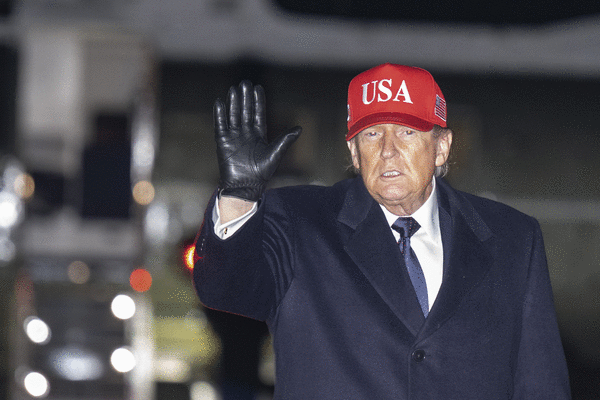
WASHINGTON — President Donald Trump on Monday refused to box himself in on how long U.S. military operations will last in Iran, saying the conflict in the Middle East could stretch a month or potentially “far longer” as he frames the mission as one that is necessary to eliminate a “colossal threat” to American interests.
“Whatever the time is, it’s OK. Whatever it takes,” Trump said at a White House event. “Right from the beginning, we projected four to five weeks, but we have the capability to go far longer than that. We’ll do it.”
Hours earlier, Defense Secretary Pete Hegseth said the duration of the military operation remains fluid, and that Trump has “all the latitude in the world” to determine how long the war in Iran will go on.
“Four weeks, two weeks, six weeks. It could move up. It could move back,” Hegseth told reporters at a Pentagon news conference.
The Trump administration’s shifting time frames and open-ended objectives in Iran have deepened uncertainty around an expanding conflict in the Middle East, particularly as the death toll of American troops killed in action rose to six and officials warned of more U.S. casualties, as the “hardest hits are yet to come.”
Gen. Dan Caine, the chairman of the Joint Chiefs of Staff, said Monday that additional U.S. military forces are already moving into the region, and warned that the conflict will not be a “single, overnight operation” and that he expects “additional losses.”
Six U.S. fatalities
The development came as military officials confirmed that three more American service members had been killed by Iranian counterattacks, and three American jets were mistakenly shot down in Kuwait in an “apparent friendly fire incident” — and as airstrikes continued to fall across the Middle East, where missile defense systems were unable to intercept every attack and deaths mounted into the hundreds, officials said.
As the U.S. and Israel continued to hammer Tehran and other targets across Iran and in Lebanon, retaliatory strikes by Iran and its allies, including Hezbollah in Lebanon, were reported in Israel as well as at U.S. facilities and other targets inside Bahrain, Cyprus, Iraq, Kuwait, Oman, Qatar, Saudi Arabia, Syria and the United Arab Emirates, according to the Associated Press.
Meanwhile, to Iran’s east, Pakistan and Afghanistan were engaged in their own battles, further destabilizing the region.
In addition to hundreds of people dead, including Iranian schoolchildren, other civilians and migrant workers in the Gulf, the fighting has impacted the world’s production of oil and natural gas — disrupting tanker traffic through the Strait of Hormuz at the southern end of the Persian Gulf and causing oil prices to shoot up.
Saudi Arabia said it intercepted Iranian drones attacking an oil refinery near Dammam, with the refinery shutting down as a precaution, the AP reported. Iran denied targeting the facility.
Air travel disrupted
The war also disrupted air traffic globally, as major airports in the Gulf, including in Dubai, halted or radically scaled back flights. The travel interruptions rippled around the world, and airline stocks tumbled.
Israel had implemented nationwide restrictions on activities as it fended off attacks from Iran and residents hid in bomb shelters. Iran reported strikes at multiple schools in the country had left young students dead.
As the conflict unfolds in real time, Trump and Hegseth have refused to rule out sending American troops into Iran, and the president has signaled that the “big wave” of military attacks is yet to come.
“I don’t have the yips with respect to boots on the ground. Like every president says, ‘There will be no boots on the ground.’ I don’t say it,” Trump told the New York Post on Monday. ”I say, ‘probably don’t need them,’ (or) ‘if they were necessary.’”
When asked by a reporter whether U.S. troops were currently on the ground, Hegseth told reporters they were not, but then bristled at further questions about potential future deployments.
“Why in the world would we tell you, the enemy or anybody, what we will do or will not do in pursuit of an objective?” Hegseth said.
The Trump administration’s objectives in the war have been equally hard to pinpoint. Trump said Saturday that the operation is aimed at razing Iran’s military and nuclear capability and dismantling its theocratic regime, and at one point even told Iranians to overthrow its government.
But on Monday, Trump said the goal is to eliminate the threats posed by the “sick and sinister regime” but not the government itself. The White House also sent a statement that outlined a mission focused on destroying Iran’s missiles, navy and nuclear program — not its leadership.
Hegseth said the attacks in Iran are not part of a “so-called regime change war, but the regime sure did change and the world is better off for it today.” The U.S. and Israel attack on Saturday killed Iranian Supreme Leader Ayatollah Ali Khamenei.
Secretary of State Marco Rubio told reporters Monday afternoon that he did not understand what the “confusion” was over the administration’s goals, or its justification for striking.
“Let me explain it to you,” Rubio said. “The United States is conducting an operation to eliminate the threat of Iran’s short-range ballistic missiles and the threat posed by their navy, particularly to naval assets.”
Rubio said the U.S. had assessed that it had to strike Iran when it did because it was “abundantly clear” that if Iran was attacked by Israel, as the U.S. believed it was going to be, it would retaliate against U.S. facilities in the region.
“We were not going to sit there and absorb a blow before we responded,” Rubio said. “If we stood and waited for that attack to come first, before we hit them, we would suffer much higher casualties, and so the president made the very wise decision.”
Looking ahead, Rubio said the “hardest hits are yet to come from the U.S. military” and said he did not know how long the operation would last.
“The next phase will be even more punishing on Iran than it is right now,” Rubio said. “The world will be a safer place when we are done with this operation.”
‘Second or third place is dead’
In an interview with ABC News on Sunday evening, Trump suggested his administration had considered some figures to replace Khamenei, but said those people are now dead.
“The attack was so successful it knocked out most of the candidates,” Trump said. “It’s not going to be anybody that we were thinking of because they are all dead. Second or third place is dead.”
The Trump administration’s messaging, meanwhile, was consistent in its vengeful rhetoric.
Hegseth and Trump both warned that any threat to Americans would be met with force.
“If you kill Americans, if you threaten Americans anywhere on Earth, we will hunt you down without apology and without hesitation, we will kill you,” Hegseth said.
Kevan Harris, an associate professor of sociology who teaches courses on Iran and Middle East politics at the UCLA International Institute, said Iran has its own capabilities to fight back regionally, and is in a neighborhood of countries with their own capabilities, too — including Saudi Arabia and Israel.
“The Middle East has more powers than just the United States as an actor,” Harris said.
“Israel has its own foreign policy agenda,” and has “basically been checking off the boxes” with the assistance of the U.S. for the last few years, Harris said. But Israel’s agenda differs from the U.S. agenda.
Harris said a long misconception in “the way the U.S. reads Iran” is the belief that Khamenei ruled the country alone, and that taking him out would create a massive leadership vacuum or a sharp shift in the nation’s policies.
While Khamenei was certainly an “intransigent” force in Iran, killing him won’t “lead to a major shift inside the country,” Harris said.
Benjamin Radd, a political scientist and senior fellow at the UCLA Burkle Center for International Relations, said whether the U.S. can get out of Iran on a relatively short timeline depends on whether those in power in Iran now are willing to negotiate terms that Khamenei and other leaders who have been killed rejected.
“If the remnants of the regime are ideologically committed to what they were under Khamenei,” Radd said, he “can’t see Trump backing down” and would expect the war to rage on.
Other leaders in Iran are fundamentalist and aligned with Khamenei, but given that the U.S. has shown a willingness and ability to capture and assassinate foreign leaders, they might back down out of self-preservation.
“In the short term, there should be a wait-and-see approach as to what this reconstituted regime looks like,” he said.
As Trump navigates the conflict in the Middle East, he has justified the strikes as America’s “last best chance” to eradicate the threat posed by the Iranian government after talks of a deal fell through last week.
“We thought we had a deal, and they backed out,” Trump said. “You can’t deal with these people. You gotta do it the right way.”
With a resolution up in the air, Trump seemed to be bothered by suggestions from unnamed people that he would lose interest if the conflict stretched for longer than two weeks.
“I don’t get bored,” he said. “There’s nothing boring about it.”
_____
©2026 Los Angeles Times. Visit latimes.com. Distributed by Tribune Content Agency, LLC.





Comments