Orban promises crackdown on 'fake' NGOs if he wins Hungary vote
Published in News & Features
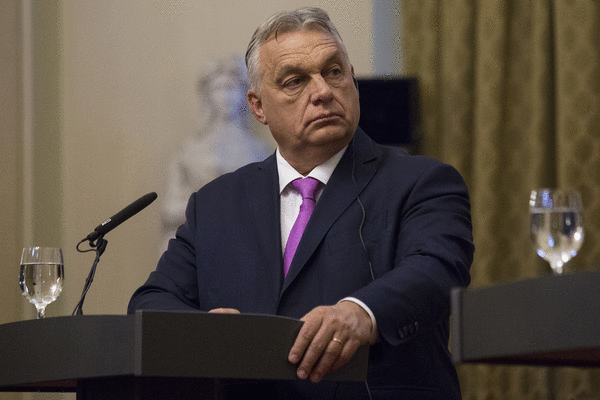
Hungarian Prime Minister Viktor Orban said he would move to stamp out what he described as “fake” opposition forces funded by Brussels if voters return him to power in a national election eight weeks from now.
Orban described the opposition Tisza party, which holds a substantial lead in most independent polls, as a “creation” of the European Union and German politicians in Brussels that, he said, would pave the way for Hungarians to be sent to war in Ukraine.
“Brussels’ machinery of repression is doing its work in Hungary, and we’ll have to clear that up after April,” Orban said in a campaign speech in Budapest on Saturday. “Fake NGOs, bought journalists, judges, politicians, algorithms, bureaucrats, millions of euros rolling around — that’s what Brussels means in Hungary nowadays.”
The speech, delivered to an invited audience and broadcast on Orban’s Facebook page, struck a conspiratorial tone as his populist Fidesz party enters the final stretch of campaigning before the April 12 ballot.
The prime minister also accused oil giant Shell Plc, the former employer of Tisza’s top economic adviser Istvan Kapitany, and Austria’s Erste Group Bank AG of supporting the opposition and benefiting from high energy prices resulting from EU sanctions on Russia.
“They make money on the war,” Orban said. “They are the death tariff collectors; they are the dogs of war.”
Shell declined to comment when contacted by Bloomberg, while Erste’s Hungarian unit referred to a statement it issued to local media saying the bank opposed all war and all violence.
Tisza’s leader Peter Magyar, a former Fidesz insider, is set to speak at a rally on Sunday after attending the Munich Security Conference, where he was scheduled to meet with Polish Prime Minister Donald Tusk and German Chancellor Friedrich Merz.
Orban has grown increasingly isolated within the EU amid allegations of corruption and crackdowns on civil society and independent media. Hungary has also repeatedly vetoed EU support for Ukraine in its defense against Russia’s invasion.
With independent polls giving Tisza a double-digit lead over Fidesz, Orban faces his toughest challenge since coming to power 16 years ago as a sluggish economy, deteriorating public services and child-protection scandals fuel public dissatisfaction with his rule.
Reports this week about dangerous toxic emissions at a Samsung battery factory, hailed by Fidesz as a flagship investment, have given the opposition another line of attack.
“Anybody seeking death tariff collectors need look no further than Samsung and the other battery factories,” Magyar wrote on Facebook on Saturday.
While Orban repeatedly stressed that Hungary’s future is secure only through close ties with Russia, which he says keep energy prices down, the reality is more complex.
The extent of fuel poverty in a country that has slipped down the ranks to become one of Europe’s poorest was starkly illustrated during January’s cold snap, when both parties competed to be filmed handing out free firewood to struggling villagers.
©2026 Bloomberg L.P. Visit bloomberg.com. Distributed by Tribune Content Agency, LLC.



Comments