Trump signals he will make Venezuela trip, praises regime's interim leader
Published in News & Features
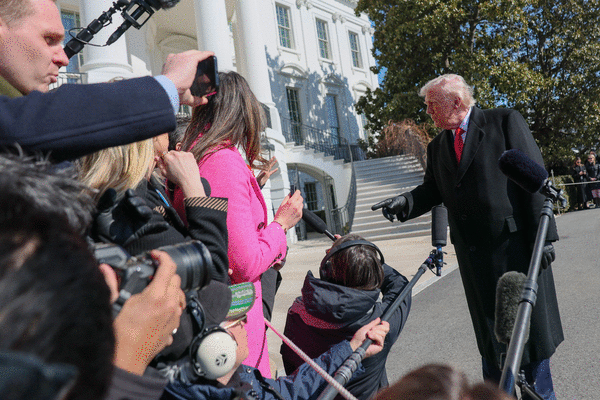
President Donald Trump said Friday that he is planning to make an official visit to Venezuela, signaling deepening ties with the country’s interim government following the January capture by U.S. forces of strongman Nicolás Maduro.
“I think I am going to make a visit to Venezuela. We haven’t decided [when],” Trump told reporters on the South Lawn of the White House before boarding Marine One.
Trump’s possible visit would mark the first trip by a sitting U.S. president to Venezuela in years and symbolize a dramatic shift in bilateral relations after a prolonged period of hostility.
The announcement underscores Washington’s formal recognition of interim President Delcy Rodríguez as Venezuela’s legitimate authority and highlights the increasingly close coordination between the two governments during the country’s U.S.-backed transition.
Asked whether his Cabinet recognizes Rodríguez’s government as his official counterpart in Venezuela, Trump replied: “At this moment, we have already done that. We are dealing with them.
“Delcy has done a very, very good, excellent job. And the relationship is solid,” he added, repeating praise he has offered in recent weeks.
Following Maduro’s capture in a U.S. raid on Caracas on Jan. 3, the Trump administration transferred control of Venezuela’s transition to Rodríguez, the former Chavista vice president, and has said the White House is supervising the process as the country moves toward stabilization and economic recovery.
Trump also emphasized progress in reopening Venezuela’s oil sector under a framework negotiated between Washington and Caracas, describing the revival of crude production as central to the transition strategy.
“The oil is flowing, and other nations are paying a lot of money for it, and we are handling it. We are refining it, and we are the only ones with the capacity to refine it,” Trump said.
His comments referred to U.S. refineries along the Gulf of Mexico that are configured to process heavy crude, the type predominantly produced in Venezuela. Once pumping more than three. million barrels per day, Venezuela’s output had collapsed in recent years due to mismanagement, corruption and U.S. sanctions.
The administration is now working to boost production while maintaining strict U.S. oversight of foreign participation in the oil sector. Officials say the goal is to stabilize Venezuela’s economy, reduce migration pressures and counter the influence of geopolitical rivals in Latin America.
U.S. Energy Secretary Chris Wright traveled to Caracas this week for meetings with Rodríguez and senior officials, reinforcing high-level engagement between the two governments. On Friday, the U.S. Treasury Department approved new licenses, further easing restrictions to allow non-Venezuelan oil companies to resume operations in the country under defined compliance conditions.
The move expands authorized activities in Venezuela’s oil sector and reflects a broader recalibration of sanctions policy. While the Trump administration previously championed a “maximum pressure” strategy, officials now argue that targeted relief tied to oversight mechanisms can accelerate economic recovery while preserving leverage.
Some major energy companies, however, remain cautious, citing ongoing political and legal uncertainties.
©2026 Miami Herald. Visit at miamiherald.com. Distributed by Tribune Content Agency, LLC.





Comments