Controversial general facing torture complaints eyed for defense post in Venezuela
Published in News & Features
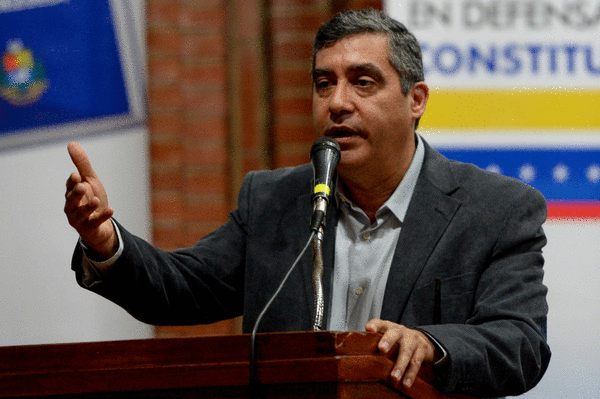
Venezuela’s interim president, Delcy Rodríguez, is considering appointing retired Gen. Miguel Rodríguez Torres as the country’s next defense minister, sources familiar with the discussions told the Miami Herald, confirming reports that have sparked indignation among members of the Venezuelan diaspora.
Rodríguez Torres’ name has resurfaced in recent days as a possible replacement for Defense Minister Vladimir Padrino López, as Rodríguez assembles what is intended to be a transition team tasked with steering Venezuela toward a democratic process in the post-Maduro era, under the supervision of the administration of U.S. President Donald Trump.
The maneuvering comes as Delcy Rodríguez has secured formal recognition from the armed forces as commander in chief. Still, U.S. and Venezuelan sources say her real authority over the military and intelligence services remains uneven, constrained by entrenched loyalties and competing power centers within the security apparatus.
It is against that backdrop that Rodríguez Torres — a former head of Venezuela’s political police and interior minister under Hugo Chávez — has resurfaced as a potential stabilizing figure within the armed forces. Supporters describe him as a chavista insider who later broke with Nicolás Maduro and who retains credibility and operational knowledge within the ranks.
A risky choice
But Rodríguez Torres is far from a risk-free choice. His appointment would likely trigger renewed scrutiny of longstanding allegations of torture and human-rights abuses, given his central role in building the machinery of repression that sustained Venezuela’s socialist regime for more than two decades.
“Delcy appears to have made up her mind about placing Rodríguez Torres at the helm of the military because she believes he is fully loyal to her, while Padrino López is not someone she completely trusts,” one source told the Herald. “But this could create a serious image problem for the interim president. While his record may not be widely known abroad, most Venezuelans are well aware that Rodríguez Torres is seen as the architect of Venezuela’s torture system.”
Sources consulted by the Herald confirmed a report published Sunday by the Spanish newspaper ABC, which said the contours of Rodríguez Torres’ possible appointment were discussed during a recent visit to Caracas by former Spanish Prime Minister José Luis Rodríguez Zapatero. The trip was publicly described as support for a fast-tracked amnesty law following the Jan. 3 capture in Caracas of strongman Nicolás Maduro in a U.S.-led operation.
The discussions come amid a fragile reordering of power in Venezuela. While the armed forces have formally recognized Delcy Rodríguez as commander in chief, U.S. and Venezuelan officials say her control over key military and intelligence units remains limited, shaped by longstanding internal loyalties.
Alarm in Washington and abroad
Rodríguez Torres, who lives in Spain after being released from prison in Venezuela in 2023, is viewed by some within the ruling camp as a figure with credibility inside the armed forces despite his rupture with Maduro, who ordered his arrest in 2018. But his possible return to a senior security role has raised alarms in both Spain and the United States, where experts and Venezuelan community leaders view his record as incompatible with a clean transition.
Gary Berntsen, a decorated former CIA station chief who advises U.S. officials on Venezuela, said he warned President Trump in a letter about the risks of allowing Rodríguez Torres to join the transition team.
“I told him: Do not let that man return to Venezuela as defense minister or as head of PDVSA,” the state-run oil company, Berntsen told the Herald. “He’s the equivalent of Klaus Barbie, the ‘Butcher of Lyon,’ during World War II. If this appointment happens, it will create enormous obstacles to restarting Venezuela’s democracy.
“Why would Delcy Rodríguez appoint a man accused of serious human rights violations — someone who created La Tumba and tortured people — to the most important security post in the country?” Berntsen said. “There is evidence that people were tortured under his command. Endorsing that is not going to work.”
“La Tumba” (The Tomb) is a notorious underground detention center in Caracas that human-rights groups say was created during Rodríguez Torres’ tenure as interior minister around 2014. Located five stories below the headquarters of the Bolivarian National Intelligence Service, SEBIN, in Plaza Venezuela, the facility is widely known inside the country as a torture center.
Rodríguez Torres has denied the allegations and says he has no open criminal investigations, has not been sanctioned and has no political ambitions.
Legal cases in Spain
Concerns over Rodríguez Torres’ human-rights record have also reached Spanish courts, where a group of Venezuelan exiles filed a criminal complaint accusing him of torture and crimes against humanity. The lawsuit also named former Venezuelan Attorney General Luisa Ortega Díaz.
Led by Dulce Lilibeth Bravo de Ocando, a Venezuelan citizen living in exile, and backed by the Venezuelan Resistance Union in Exile and the group Manos Limpias, the complainants argued that Rodríguez Torres was personally responsible for the torture and death of hundreds of Venezuelans while he served as head of the feared intelligence service, now known as SEBIN.
Luis Ortiz, president of the Union of the Venezuelan Resistance in Exile, said in a telephone interview that his organization decided to pursue the case in Spain after learning that both Ortega Díaz and Rodríguez Torres were residing in the country.
“When we learned that Luisa Ortega Díaz had arrived in Spain, and that former Spanish Prime Minister José Luis Rodríguez Zapatero had acted as a bridge to bring Miguel Rodríguez Torres here as well, we understood that the conditions existed to move forward legally,” Ortiz said.
Ortiz described Rodríguez Torres as a central figure in the transformation of Venezuela’s intelligence services into what human rights groups describe as a repressive apparatus.
“Rodríguez Torres is not a minor figure,” Ortiz said. “He dates back to Chávez’s 1992 coup attempt and became one of his most trusted men. Chávez entrusted him with transforming what had been a state police force into a political police — a repressive, torturing force that later became known as SEBIN.”
Ortiz said Rodríguez Torres went further by overseeing the creation of clandestine detention facilities.
“He was not only responsible for that transformation,” Ortiz said. “He went so far as to create a torture center — the facility known as La Tumba — where many people were tortured. Some of those victims are part of our complaint.”
The case of Dulce Bravo
Addressing the case of Dulce Lilibeth Bravo de Ocando, Ortiz said her testimony was central to the lawsuit.
“We provided direct evidence from victims, including Dulce Bravo, who is now in exile in Argentina,” Ortiz said. “She is one of the direct victims of Rodríguez Torres. According to her testimony, he personally threatened her and ordered her physical torture.”
Ortiz said Bravo’s account describes extreme sexual violence during her detention.
“To put it plainly, she was raped by multiple agents while being tortured,” Ortiz said. “That is part of her sworn testimony. It is not an allegation made lightly, and it is supported by medical and testimonial evidence.”
Ortiz said Bravo was not the only victim cited in the case.
“In addition to Dulce Bravo, there are other emblematic cases — including Lorenza Aleta — and at least 13 victims selected for the initial filing,” Ortiz said. “But our organization has documented nearly 70 victims who are prepared to participate in future proceedings.”
Jurisdictional ruling
Ortiz said the dismissal of the case by Spain’s National Court on jurisdictional grounds did not undermine the substance of the allegations.
“The court did not rule on the facts,” Ortiz said. “This is about jurisdiction, not innocence. Our evidence remains intact, and we intend to continue pursuing justice wherever possible.”
In detailed sworn testimony submitted as part of the lawsuit, Bravo accused Rodríguez Torres of ordering and personally overseeing her detention and torture — including rape by intelligence agents — during incidents in 2003 and 2004.
Spain’s National Court confirmed in January that the complaint was inadmissible on jurisdictional grounds, because the alleged crimes occurred in Venezuela. The court did not assess the merits of the allegations. Lawyers for the plaintiffs say they plan to appeal.
Allegations of abduction, torture
In her testimony, Bravo said she began organizing women’s civil society groups in late 2002 amid growing protests against Chávez’s government. Though not affiliated with a political party, she worked closely with dissident military officers gathered at Plaza Altamira, then a focal point of opposition activity.
On May 9, 2003, Bravo said, she was abducted near the plaza by men she later identified as intelligence agents. She alleged she was chemically sedated, interrogated and threatened before being abandoned hours later outside a church in western Caracas. Medical records cited in her testimony say she required months of treatment for chemical intoxication.
The most severe episode described in her account occurred the following year. On May 10, 2004, Bravo said agents of Venezuela’s intelligence service, then known as the DISIP, raided a private residence without a warrant, beat and detained her, and took her to El Helicoide, the agency’s main detention complex.
There, she alleged, she was subjected to prolonged interrogations, beatings and sexual assault by intelligence agents.
Bravo said she was later brought before Rodríguez Torres, then director of the DISIP, whom she accused of verbally abusing her, threatening her and attempting to coerce her into providing information about dissident military officers.
She said she was forced at gunpoint to sign documents stating she had not been tortured.
Her testimony also alleges that prosecutors blocked her from testifying in civilian court and that she was transferred to military jurisdiction, accused of crimes including treason, rebellion and terrorism. She was detained for nearly two months at the Ramo Verde military prison before being released, with the case eventually shelved.
_____
©2026 Miami Herald. Visit miamiherald.com. Distributed by Tribune Content Agency, LLC.





Comments