First US deportations since Maduro's capture arrive in Venezuela
Published in News & Features
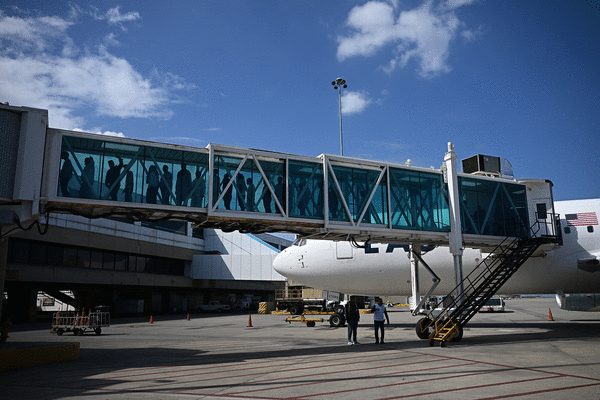
A plane carrying deported immigrants landed in Venezuela on Friday — the first removals from the United States since the Trump administration captured Venezuelan leader Nicolás Maduro.
The six-hour flight departed from the Mesa Gateway Airport in Phoenix and landed in Simón Bolívar International Airport, according to U.S. watchdog group Human Rights First, a flight monitor of Immigration and Customs Enforcement, and online flight trackers and journalists in Caracas.
Eastern Air Express, which carries out a significant number of deportations for ICE, was the carrier. Local media reported that the manifesto listed 231 people but that 199 passengers had arrived. It also published photos of the plane arriving on the tarmac.
The flight appears to be the first U.S. deportation flight in over a month to Venezuela. The last one that advocates, experts and journalists tracked was on Dec. 10. Two days later, the Venezuelan government announced the U.S. had unilaterally suspended flights amid escalating tensions. Neither ICE nor the Department of Homeland Security responded to a request for comment from the Miami Herald about who was deported and how many people were on the flight.
Friday’s flight raises questions about how negotiations between Caracas and Washington will affect future deportations. President Donald Trump has made Venezuelans a principal target of his aggressive mass deportation efforts. He stripped deportation protections for more than a half-million Venezuelans who had Temporary Protected Status, leaving them vulnerable to being sent back to Venezuela, where millions have fled political repression and extreme poverty.
Between February and December 2025, the government sent 14,310 deportees to Venezuela on 76 flights, according to watchdog group Human Rights First.
During the hold on the deportation agreement between the U.S. and Venezuela, hundreds of Venezuelans were deported to Mexico. The Herald reported that deported and detained Venezuelans, as well as their families, said immigration agents had offered to send them to countries like Honduras, Colombia, Nicaragua and Ecuador, as well as Uganda, an East African nation with no shared language or cultural ties to Venezuela.
A day after meeting Trump in Washington, Venezuelan opposition leader Maria Corina Machado told reporters that the Venezuelan government has used migration from the South American country as a bargaining chip. When asked about the first deportation flight of Venezuelans after Maduro’s capture, she said the only pathway for the millions Venezuelans to return is to “give the people certainty that we will have a democratic future.”
Venezuela has been experiencing a humanitarian crisis for more than a decade, forcing over 8 million people to flee their country amid economic collapse, political turmoil and shortage of necessities. The U.S. has become one of the primary destinations for the exodus, with over 800,00 Venezuelans living in the country, many in South Florida.
About 5.1 million people in Venezuela face hunger, according to the United Nations, and over half of the population is living in extreme poverty. There are shortages of basic supplies like gasoline and medicine, power and water outages are common, and healthcare infrastructure is inadequate. Violent crime is also common, and the government violently represses journalists and dissidents
While the Department of Homeland Security under Trump ended deportation protections for Venezuelans saying that their country was safe to return to, the State Department warns Americans to avoid travel to the country under any circumstance.
_____
©2026 Miami Herald. Visit miamiherald.com. Distributed by Tribune Content Agency, LLC.






Comments