Machado presents Nobel Peace Prize medal to Trump in White House meeting
Published in News & Features
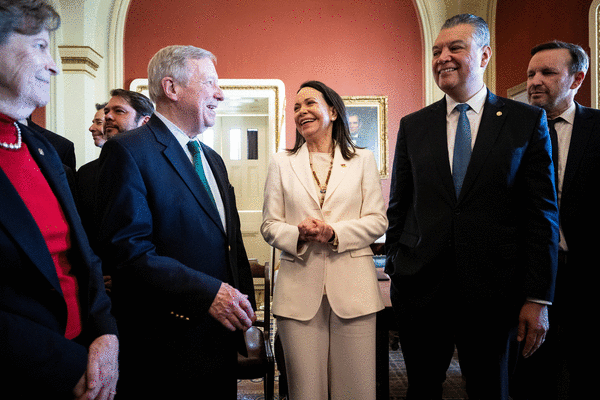
Venezuelan opposition leader María Corina Machado said Thursday that she presented President Donald Trump with her Nobel Peace Prize medal during her meeting with him at the White House, where the two discussed the South American country’s future.
Neither Machado nor the White House has said whether Trump accepted the medal, which was awarded to the opposition leader last year for her courageous, nonviolent struggle for democracy in Venezuela. Trump has previously expressed interest in winning the Nobel Peace Prize himself.
“I presented the Nobel Peace Prize medal to the president of the United States,” Machado told reporters outside the U.S. Capitol in Washington, suggesting she may have offered the medal to Trump as a personal gesture.
Machado said she used the moment to recount a historical episode linking the two countries’ independence movements, involving the Marquis de Lafayette — the French officer who fought alongside the American colonies — and Simón Bolívar, the Venezuelan liberator.
Two centuries ago, she said, Lafayette gave Bolívar a medal bearing the image of George Washington, commander of the American revolutionary forces and the nation’s first president.
“Bolívar kept that medal for the rest of his life,” Machado said. “In fact, when you look at his portraits, you can see the medal.”
She described her gesture as a symbolic return of that fraternity.
“Lafayette gave it to him as a symbol of brotherhood between the people of the United States and the people of Venezuela in the fight against tyranny,” Machado said. “Two hundred years later, Bolívar’s people are returning a medal to Washington’s leader — in this case, the Nobel Peace Prize medal — as recognition of his special commitment to our freedom.”
Machado’s comments came after her meeting with Trump at the White House, where the two discussed Venezuela’s political future as the Trump administration pursues a dual-track strategy that combines outreach to opposition figures with intense pressure on Venezuela’s interim government through oil sanctions, maritime enforcement and tightly managed economic incentives.
White House Press Secretary Karoline Leavitt said the meeting was under way as she exited the Oval Office, calling Machado “a remarkable and brave voice for many of the people of Venezuela.”
“The president was looking forward to this meeting and expecting a frank and positive discussion,” Leavitt said. “He wants to hear directly from Ms. Machado about the realities on the ground in Venezuela and what is taking place in the country.”
The meeting comes as the Trump administration moves to seize and sell tens of millions of barrels of Venezuelan oil as part of a three-phase strategy outlined last week by Secretary of State Marco Rubio. The plan aims first to stabilize Venezuela, then to reopen its economy under U.S. oversight, and ultimately to guide the country toward a democratic transition.
Rubio told reporters that U.S. officials are preparing to take control of between 30 million and 50 million barrels of Venezuelan crude currently immobilized by sanctions and a U.S.-enforced maritime quarantine. At current market prices, that oil could be worth between $1.4 billion and $2.4 billion.
“We’re going to sell it at market prices, not at the steep discounts Venezuela was getting before,” Rubio said last week. He added that the proceeds would be strictly controlled to ensure they “benefit the Venezuelan people, not corruption or the regime.”
Against that backdrop, Trump’s meeting with Machado underscores the administration’s continued engagement with Venezuela’s opposition, even as Washington works closely with interim socialist authorities in Caracas following the capture of longtime strongman Nicolás Maduro earlier this month.
Led by Maduro’s former vice president, Delcy Rodríguez, the new interim government in Venezuela is composed largely of the same officials who, alongside the former strongman, have been charged in the U.S. with turning Venezuela into a narco-state and accused of committing serious human-rights abuses.
Yet U.S. officials say those authorities are needed in Caracas to create the conditions for a transition to democratic rule.
At Thursday’s press conference, Leavitt acknowledged that Trump’s skepticism about Machado’s ability to operate freely inside Venezuela remains unchanged. Trump has previously said it would be difficult for Machado to lead the country or exert influence due to what he described as insufficient support and protection.
“That assessment was based on realistic ground realities from what the president has been hearing from his advisors and national security team,” Leavitt said. “At this moment in time, his opinion on that matter has not changed.”
Still, she said Trump was eager to meet Machado in person and hear her perspective.
“He was expecting it to be a good and positive discussion,” Leavitt said.
Leavitt reiterated Trump’s commitment to elections and a democratic transition in Venezuela, but offered no timeline.
“The president is committed to seeing elections in Venezuela when the time is right,” she said. “He is committed to a transition to democracy, but I don’t have an updated timetable to share today.”
The aggressive enforcement of oil sanctions — including what U.S. officials describe as a de facto maritime quarantine of sanctioned Venezuelan tankers — forms the backbone of the first phase of Washington’s plan, focused on stabilization.
In recent weeks, U.S. authorities have escalated enforcement at sea, intercepting six tankers linked to sanctioned Venezuelan oil exports, according to U.S. officials.
At the center of Washington’s leverage is control over Venezuela’s oil revenue, long the country’s economic lifeline.
Leavitt said the administration has been in “constant communication” with Venezuela’s interim president, Delcy Rodríguez, the former vice president under Maduro who now leads the provisional government.
“The president spoke with Ms. Rodríguez directly this week,” Leavitt said, confirming Trump’s own public remarks a day earlier. “Secretary Rubio and the administration have been in constant communication with her and other members of the interim government.”
Leavitt described Venezuelan authorities as “extremely cooperative,” saying they have met “all of the demands and requests of the United States and of the president.”
That cooperation, she said, has already produced tangible results: a $500 million energy deal involving U.S. participation and the release of political prisoners, including five Americans freed this week — a development closely watched by Venezuelan-American communities in Florida.
“The president likes what he’s seeing and expects that cooperation to continue,” Leavitt said.
Venezuela’s state oil company, PDVSA, has for the first time publicly acknowledged talks with the United States to sell crude under new arrangements. In a statement last week, the company said discussions were taking place “under frameworks similar to those currently in effect with international companies such as Chevron” and described the potential transactions as “strictly commercial.”
The second phase of Washington’s plan, which Rubio has described as “recovery,” would focus on reopening Venezuela’s economy under transparent rules designed to attract U.S., Western and allied investment after years of sanctions, corruption and political instability drove most foreign companies away.
U.S. officials envision a system that allows equal access to the energy sector while gradually easing restrictions in exchange for political concessions. At the same time, Washington hopes to push a process of national reconciliation, including amnesties for opposition figures, the release of remaining political prisoners and the return of Venezuelans in exile — issues of particular importance to South Florida’s large Venezuelan diaspora.
_____
©2026 Miami Herald. Visit at miamiherald.com. Distributed by Tribune Content Agency, LLC.




Comments