Who is Kamar Samuels, NYC's new schools chancellor? His plans on integration, gifted programs and more
Published in News & Features
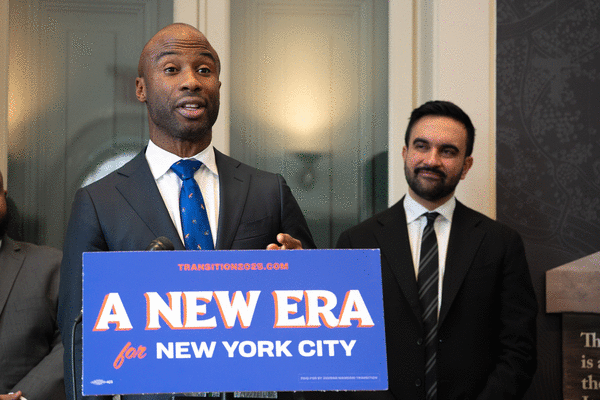
NEW YORK — When Mayor Zohran Mamdani tapped Kamar Samuels to lead New York City’s public schools, the chancellor could’ve expected his new gig would involve putting out fires — metaphorically.
Intsead, two five-alarm fires broke out in the Bronx and Queens on the first couple of days of classes after the winter break. The blazes sent displaced families seeking shelter in nearby public schools, and thrust Samuels into the daunting task of comforting parents and their children on what may well have been the worst days of their lives. All on his first week on the job.
In an exclusive interview with The New York Daily News as he shuttled between a Corona preschool and the Ridgewood school where families found refuge on Tuesday, Samuels reflected on his rise: his background, experience and the lessons he takes with him as the new leader of the nation’s largest school district.
The Daily News caught up with Samuels at the Mosaic Pre-K Center at the New York Hall of Science, where he met with parents, teachers and local elected officials and toured an example of a leading early childhood program. But his visit was cut short when he was called on to visit 29 people, representing 10 families, sheltering in the auditorium of P.S. 239.
Samuels speaks often about his two eldest children, who are enrolled in the city’s school system. But he’s also the dad of a 2-year-old, as Gov. Kathy Hochul and Mamdani start to expand universal child care programs to that age group. He hears from other parents with kids the same ages frequently.
“I talk to parents all the time who have two issues: They’re leaving the city because they had their second child and they can’t afford child care, and so they can’t afford to live in the city anymore,” the chancellor said after the tour.
“Another reason families are leaving the city, they tell me, is because they feel like they can’t necessarily find the high-quality school in their neighborhood. And so, that’s why we want to make schools that are safe, rigorous and truly integrated.”
Samuels has ideas about how to do that, many from his own experience as a local schools superintendent of two districts in Brooklyn and Manhattan, he told the Daily News.
Before stepping into his role as chancellor, Samuels first made headlines at the helm of a number of gutsy school mergers to address low enrollment, such as P.S. 305 with the Academy of Arts and Letters in Bedford-Stuyvesant and Fort Greene, which the chancellor visited with Mamdani on Thursday, as well as West Side Collaborative with Lafayette Academy and P.S. 76 A. Philip Randolph with Mott Hall II in Harlem.
Each time, local parents took their concerns to public hearings and the media, fearful of what the proposed changes would mean for the history and identity of their schools. And yet, in all three examples, education officials ultimately moved ahead with the mergers — frequently combining schools with distinct student bodies in terms of race and class. The city’s schools are some of the most segregated by race in the country.
“What we needed to do was to make sure both communities felt like they would be affirmed in the process and get something that was beneficial to all. That wasn’t easy to do,” Samuels said. “We need to acknowledge that people are weary of integration efforts. In particular, some of our most historically marginalized families, many of them feel that they might have not gotten benefits of integration efforts in the past.”
There may be more school mergers in the years to come, especially in light of a law to lower class sizes. The new caps will require that the system make the most out of its available space, to avoid construction costs and controversial reforms, such as limiting enrollment at popular, but overflowing, schools.
“We want our kids to be in lower class sizes so that they can get the attention that they truly need,” Samuels said. “We have some places that are under-utilized, and some places that are over-utilized. Before we start talking about new buildings, we need to look at the buildings that we have and make sure that we’re using them appropriately.”
“We want to avoid enrollment caps — that is the truth — as much as we can. Because when families don’t get their first choice, they many times leave the system.”
As a local superintendent, Samuels was also involved in a community-led effort to phase out Gifted and Talented programs in Brooklyn’s District 13, and replace them with other types of rigorous programs. The chancellor said he plans to have conversations with Mamdani, a critic of so-called “G&T” in the early grades, about instruction for fast-learners.
“It was definitely not initiated by me, but I would say I helped in the process,” Samuels said. “I know that gets a lot of attention, but I think the question about G&T is all about, how do we provide access to accelerated programs? I believe we need to have accelerated programs in our city and we should think about how we do that, and that’s what the mayor and I will be discussing.”
As he assumes the position of chancellor with leadership experience, Samuels will also rely on his own personal history — a Jamaica-born immigrant and former elementary school math teacher in the Bronx — as he confronts some of the largest challenges the system faces today.
Despite large class sizes at some of the most in-demand schools, citywide enrollment has dropped dramatically since before the pandemic, fueled in part over the last year by a loss of families believed to be undocumented immigrants.
“I am an immigrant myself,” said Samuels, who moved to New York from Jamaica when he was 15. “I am working and fighting to make sure that they are integrating into a city that is an easier city to connect to, that they can work hard and accomplish the things that they want to, and that everyone deserves a school that will really be a place where they feel like they belong.”
And keeping with the key responsibility for any educational system leader, Samuels will also be held accountable for kids’ academic performance, as schools continue to adopt new reading and math curricula. The chancellor promised to keep those initiatives in place, as well as another program focused on career readiness.
In the back of the car, Samuels had yet to unload a personal gift from his first school day as chancellor: A 3-foot-tall “Welcome Chancellor Kamar Samuels” sign, featuring both his professional headshot and a photo from his time as a teacher. It was given to him by the Bronx school, P.S. 194, where he started his career in education decades ago as a teaching fellow.
“Nobody sends their kid to a chancellor. They send their kid to a teacher or a school or a principal,” Samuels quipped.
“The biggest, the most important initiatives are not only going to continue, but we’re going to bolster them and double down on them,” he added. “Between now and the end of the year, it’s going to be a seamless transition for schools.”
At P.S. 239, Samuels visited the temporary fire victims shelter in the school auditorium, shaking the hands of affected families and thanking staff for stepping up. In the back of the room, donations — coats, shoes and undergarments — continued to pile up throughout the morning, including two stuffed animals: a giraffe and Minnie Mouse.
“The school is here,” Samuels assured a mom and her daughter.
©2026 New York Daily News. Visit nydailynews.com. Distributed by Tribune Content Agency, LLC.





Comments