After Maduro capture, US warns Diosdado Cabello: Cooperate or be next
Published in News & Features
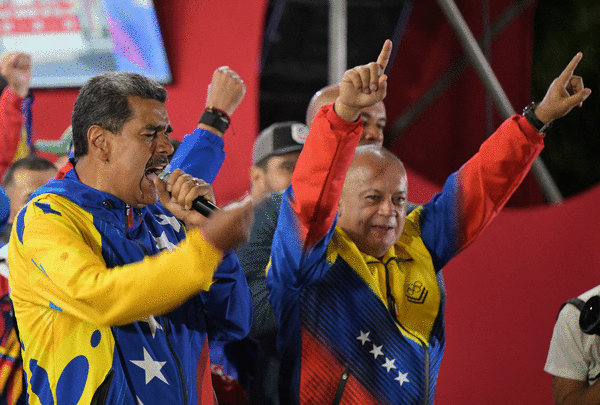
The Trump administration has warned Venezuela’s most feared power broker that he could be next unless he falls in line.
The Reuters news service has reported that U.S. officials have put Interior Minister Diosdado Cabello on notice that cooperation with Washington is now a condition for survival as Venezuela navigates a volatile post-Maduro transition.
Citing three people familiar with the matter, Reuters reported that U.S. officials have informed Cabello through intermediaries that defiance could place him on a fast track to the same fate as former strongman Nicolás Maduro, who was captured in a U.S. raid Saturday and flown to New York to face federal “narco-terrorism” charges.
Cabello, one of the most feared figures of Venezuela’s ruling elite, controls security forces accused of widespread human-rights abuses and has long been seen as a hardline enforcer of the socialist regime. He is also viewed by U.S. authorities as one of the top leaders of the so-called Cartel de los Soles, a drug trafficking network the U.S. government alleges is embedded within Venezuela’s military and political leadership. Washington has offered a $25 million reward for information leading to Cabello’s capture.
Despite his reputation, U.S. officials now view him — uneasily — as one of a handful of Maduro loyalists temporarily relied upon to maintain order as Interim President Delcy Rodríguez attempts to govern in the aftermath of Maduro’s downfall, Reuters reported.
The strategy, however, is fraught with risk. U.S. officials worry that Cabello — long viewed as a rival of Rodríguez and a symbol of the regime’s coercive power — could deliberately undermine the transition if he feels sidelined or threatened. According to people familiar with internal deliberations cited by Reuters, Washington is attempting to box him in: extracting short-term cooperation while quietly preparing options to remove him from the political landscape altogether, potentially through exile.
Any direct move against Cabello carries the danger of triggering unrest. Pro-government paramilitary groups known as colectivos, which have historically answered to figures like Cabello, could flood the streets if they believe their protector is under attack. U.S. officials fear such a reaction could spiral into violence at a moment when Washington is determined to avoid deploying American ground troops.
Of all of Rodríguez’s potential rivals, Cabello is seen as the most dangerous — and far harder to neutralize, sources told the Miami Herald.
Unlike Maduro, who ruled surrounded by layers of security and ritualized power, Cabello has adapted to survival mode. Sources compare his tactics to those of guerrilla leaders: sleeping during the day, moving constantly at night, personally managing his routes and security, and never remaining in one place long enough to be targeted.
“Maduro ruled like a king,” one source said. “Diosdado lives like an insurgent.”
Cabello’s strength lies not only in his evasive tactics but also in his street-level network. Sources estimate he maintains direct control or influence over roughly 30 highly violent operatives, with access to an additional 220 members of the Venezuelan Honor Guard. Many are drawn from intelligence and police units and view themselves as ideological combatants preparing for a prolonged confrontation.
Their objective, according to sources, is not to defeat the United States outright but to provoke it — drawing U.S. forces into an urban and jungle conflict where American casualties could shift public opinion at home.
Audio recordings obtained by sources and shared with the Miami Herald suggest Cabello is actively working to shore up his forces. In the recordings, he speaks of retaliation and national resistance against what he views as betrayal, reaching out to loyalists in the industrial state of Carabobo, the cattle-producing plains of Los Llanos, the oil-rich state of Zulia, and the capital, Caracas.
In one recording, Cabello pledged revenge.
“These rats attacked us, and they are going to regret it for the rest of their lives,” he said. “Let’s reorganize now, assess where the attacks were, the damage we have, and keep moving forward — always forward, always united.”
Cabello is not the only senior figure under pressure. Defense Minister Vladimir Padrino López — who commands the armed forces — is also accused by U.S. authorities of being a member of the Cartel de los Soles. Like Cabello, Padrino is under U.S. indictment on drug trafficking charges, and the U.S. government has offered a $15 million reward for information leading to his capture.
According to Reuters, U.S. officials believe Padrino is more pragmatic, less ideologically rigid and potentially open to negotiating a safe exit in exchange for helping prevent a breakdown of military discipline.
“This remains a law enforcement operation, and we are not done yet,” a U.S. Justice Department official told Reuters, underscoring that the arrests of Maduro and other figures are not being treated as isolated actions.
_____
©2026 Miami Herald. Visit miamiherald.com. Distributed by Tribune Content Agency, LLC. ©2026 Miami Herald. Visit at miamiherald.com. Distributed by Tribune Content Agency, LLC.



Comments