Xi is testing Japan's ties with Trump by escalating trade battle
Published in News & Features
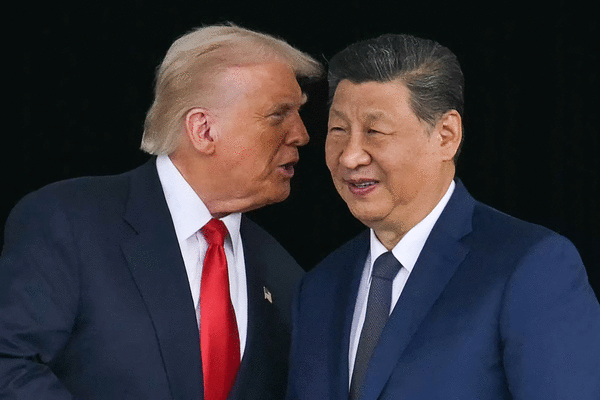
China is testing Donald Trump’s support for America’s top ally in Asia by imposing export controls on Japan months after the U.S. leader boasted he’d settled the rare earth issue “for the world.”
Beijing turned up the heat on Tokyo this week by banning all dual-use shipments for military use — potentially targeting an estimated 40% of Chinese exports to its neighbor — and threatening tighter controls on rare earths that underpin Japan’s auto sector. Hours later, China opened an anti-dumping probe into a key chipmaking material, taking aim at another pillar of Japanese industry.
Taken together the moves show President Xi Jinping’s pressure campaign against Prime Minister Sanae Takaichi over her comments on Taiwan is just getting started. Restricting rare earths also delivers a direct challenge to Trump, after the U.S. leader boasted he’d resolved that problem during a meeting with China’s top leader, which saw Beijing vow to keep sending metals vital to making everything from jets to missiles.
For now, Takaichi appears to be weighing her options. While her government has protested China’s latest actions, she’s so far refrained from any tit-for-tat response that would risk greater blowback at home, where Japanese carmakers rely on Chinese-sourced inputs to produce electric vehicles.
“Japan’s default approach to China’s policy tantrum is to avoid seeking a compromise off-ramp, but also to avoid any leaps toward retaliation,” said Kurt Tong, a former senior U.S. diplomat in Asia who’s now a managing partner at the Asia Group. “Rather, it aims to patiently wait out China and expect it to calm down eventually.”
Bolstered by strong support at home, Takaichi has refused to retract her comment that suggested Japan could deploy its military if China tried to seize self-ruled Taiwan, despite repeated demands from Beijing. The dispute comes at a delicate diplomatic moment as Trump tries to preserve a truce with China ensuring America’s own supply of rare earths and ahead of a much-touted April summit with Xi in Beijing.
By contrast, the next scheduled opportunity for Xi and Takaichi to engage in leader-to-leader diplomacy is at the Asia-Pacific Economic Cooperation summit in Shenzhen this November — meaning Japan likely faces months of economic pain.
“Traditionally, Japan’s diplomacy has followed a clear pattern: First you lock in the relationship with the U.S., and then face China. But the situation now is completely different,” said Ryo Sahashi, professor of international politics at the University of Tokyo. “U.S.–China relations are relatively good, so Japan can’t use its old trick of negotiating with China via the U.S. anymore.”
“There are really only two options left: Either engage seriously in diplomacy with China or leave things alone for the time being,” he added.
Japan is keeping the U.S. in the loop as ties with the world’s No. 2 economy continue to fray.
Just days ago, Takaichi said she had an “extremely meaningful” call with Trump and would visit the U.S. later this year. After curbs were announced this week, Masaaki Kanai, an assistant minister at Japan’s Foreign Ministry, spoke with his U.S. counterpart, with the two officials affirming “close coordination” according to a Japanese statement, which didn’t elaborate on specifics.
“What Takaichi needs is a direct, supportive message from the Trump administration toward China — one that clearly says Japan isn’t in the wrong, and that also includes criticism of China,” said Daisuke Kawai, director of the University of Tokyo’s economic security and policy innovation program.
China is also trying to rally support. Its export controls appeared carefully orchestrated to drive a wedge between Japan and the other key U.S. ally in the region — South Korea. Beijing unveiled the measures hours after South Korea’s Lee Jae Myung posed for selfies with Xi during the first state visit to China by a South Korean leader since 2019.
Those optics stood in contrast with the solidarity on display less than three years ago, when the leaders of Japan, South Korea stood with then U.S. President Joe Biden at a historic summit at Camp David to inaugurate a “new era” of partnership to counter growing threats from China and North Korea.
“For us, relations with Japan are as important as those with China,” the South Korean president told reporters in Shanghai on Wednesday, underscoring the balancing act facing regional partners as the dispute rumbles on.
If things escalate further, Japan has ways it can fight back. It dominates key semiconductor sectors, controlling as much as 90% of the advanced photoresist market. Export curbs in that area could cripple China’s chip ambitions, according to Bloomberg Economics, which wrote that finding alternatives could take years.
But Tilly Zhang, a China analyst at Gavekal Dragonomics, said the country’s demand for high-end photoresist could be limited since it already faces restrictions on importing the advanced machines used to manufacture the latest chips.
“My overall sense is that whatever could be choked off has already been choked off,” she said. Japanese companies selling a large amount of non-high-end semiconductor manufacturing equipment to China could get hurt in any serious retaliation, according to Zhang.
For now, it remains unclear how China’s export controls will affect Japan’s economy, as the vague wording of the measures leaves Beijing plenty of flexibility. “This is serious, but so far strikes me as a further warning shot, not a death blow,” said Cory Combs, associate director at consultancy Trivium China.
For China, diplomatic and economic efforts to pressure Tokyo so far have failed, said Wu Xinbo, director at Fudan University’s Center for American Studies in Shanghai. That means more powerful measures are required.
“We should restrict and suppress Japan’s military capabilities and defense industry, so as to deprive it of the ability to intervene on Taiwan,” he added.
--------
—With assistance from Jing Li, Yoshiaki Nohara and Josh Xiao.
©2026 Bloomberg L.P. Visit bloomberg.com. Distributed by Tribune Content Agency, LLC.






Comments