Netanyahu meets Trump as Gaza ceasefire approaches crossroad
Published in News & Features
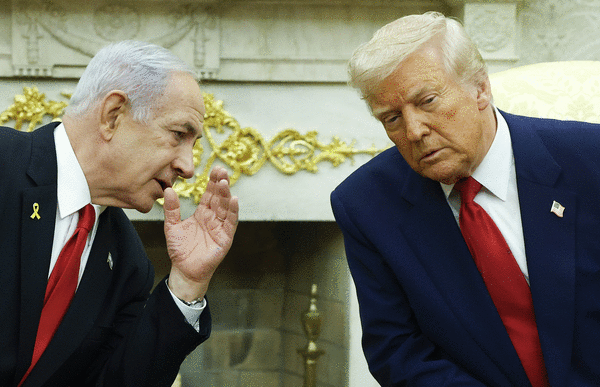
Israeli Prime Minister Benjamin Netanyahu and U.S. President Donald Trump will meet Monday to discuss the ceasefire in Gaza, whose troubled opening months are stoking concern that regional fighting could resume in the new year.
Trump is to host Netanyahu, his most frequent foreign guest, at his Mar-a-Lago estate in Florida after hearing complaints from Arab and Muslim partners about continuing Israeli military strikes in the war-shattered and now-divided Palestinian enclave, as well as in Lebanon and Syria.
Israel says it’s fending off fresh threats by armed Islamist groups. Chief among these is Hamas, which triggered the two-year conflict in the Gaza Strip and agreed to the truce and a full hostage release — but not to surrender weapons as demanded by Trump’s internationally endorsed 20-point peace plan. The group has said it might be willing to integrate into the military of a future Palestinian state.
In Lebanon, Israel has been hitting Hezbollah and accusing the Beirut government of lagging in its promise to prevent the militia from rearming and regrouping at the border.
Netanyahu’s goal in the Trump talks will be to “strengthen, preserve and safeguard the achievements of the war and thus ensure that the offensive capabilities that we denied our enemies won’t be restored,” said Guy Levy, a Netanyahu spokesman.
Trump has been highly supportive of Israel even as it faced censure elsewhere over the Gazan carnage. When Netanyahu took the war to Iran — the sponsor of Hamas and Hezbollah — in June, U.S. strategic bombers joined Israel’s air force in the assault on its nuclear facilities.
But the president has shown impatience with questions of when and how his Gaza plan can move to the reconstruction and reconciliation stages, known as Phase 2.
Israelis, meanwhile, are bracing for more war. A poll by the Israel Democracy Institute think tank found that 71% of the public believe there will be a flare-up with Hezbollah in the coming year. Sixty-nine percent see it happening with Iran, and 53% with Hamas.
“No one is arguing that the status quo is sustainable in the long term, nor desirable,” U.S. Secretary of State Marco Rubio, who is also due to meet Netanyahu on Monday, said in a Dec. 19 news conference. “And that’s why we have a sense of urgency about bringing Phase 1 to its full completion.”
Trump is expected soon to name fellow global leaders to a “Board of Peace” to oversee the interim administration of post-war Gaza. Formation of an International Stabilization Force, also known as ISF, consisting of troops from other countries, should soon follow.
Yet Israeli and U.S. officials privately acknowledge arguing over whether Israel should withdraw troops and tanks from parts of the 53% of the territory it still holds, and hand them over to the ISF, even as Hamas remains armed and defiant in the rest.
It’s also unclear whether the ISF would be willing and able to confront Hamas, which is branded a terrorist group in the West.
Another sticking point has been over Hamas’ failure to return the body of the last of the some 250 people it seized during the Oct. 7, 2023 shock invasion of southern Israel. Hamas blames technical difficulties for the holdup. Israel accuses it of playing for time.
“We mustn’t move even a meter before getting (the hostage) Rani Gvili,” Itamar Ben Gvir, a member of Netanyahu’s security cabinet, told Tel Aviv radio station 103 FM.
“To my regret, Hamas still exists,” he added, addressing his remarks to Trump: “You too, Mr. President, said that they need to be dismantled and disarmed. As long as that doesn’t happen, there cannot be movement on anything.”
Since the U.S.-backed ceasefire took effect in October, periodic Israeli strikes and operations in Gaza have continued, although large-scale combat has largely come to an end. Israel has said its sporadic strikes were caused by Hamas violations of the truce. The Palestinian group has accused Israel of undermining the ceasefire deal and limiting aid into the enclave.
Netanyahu has talked up the possibility of expanding the Abraham Accords under which Trump, in his first presidential term, forged relations between the Jewish state and several Arab powers.
Trump has befriended Syrian President Ahmed Al-Sharaa, an ex-jihadi who toppled his predecessor, Bashar al-Assad, a year ago. Assad was an Iranian ally and fell in part due to Israel’s victories over Iran and its Lebanese ally Hezbollah. But Sharaa has been cool to ideas of reconciliation with Israel, citing its occupation of Syrian land for a deepened buffer zone.
Last week, Israel became the first country to recognize Somaliland, a move Netanyahu described as being “in the spirit of the Abraham Accords.” But Trump sounded in no rush to follow suit as U.S.-aligned powers Turkey, Egypt and Qatar - all of them Hamas intermediaries - condemned what they deemed a blow to Somalia’s territorial integrity.
©2025 Bloomberg L.P. Visit bloomberg.com. Distributed by Tribune Content Agency, LLC.






Comments