Xi's triumphant year staring down Trump belies troubles in China
Published in News & Features
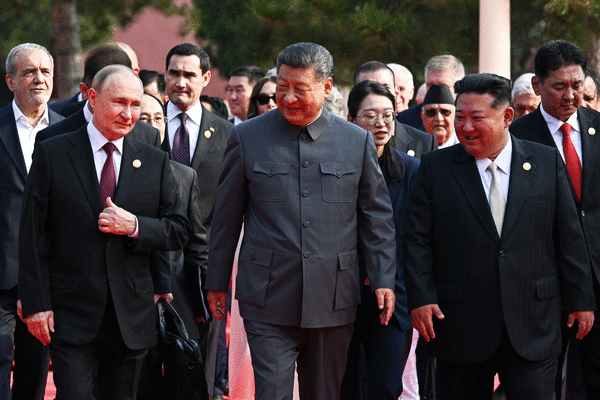
For President Xi Jinping, what began as a challenging year is ending on a note of triumph.
China was peerless in confronting Donald Trump’s renewed trade war, wielding its dominance over rare earths to extract concessions on tariffs and export controls. Chinese shipments found new homes outside the U.S., pushing its trade surplus beyond $1 trillion for the first time. Despite Washington’s curbs, the Asian country’s artificial intelligence firms pressed ahead and its chipmakers raced to the IPO market, buoyed by Xi’s call for technological self-reliance.
On the diplomatic stage, Xi projected strength. Flanked by two dozen foreign leaders, he presided over a grand military parade in Beijing, showcasing China has the hard power to back up his vision for a new world order. Weeks later, Xi sat down with Trump in South Korea for what the U.S. president called a “G2 meeting” — rare language validating Beijing’s long-standing desire to be treated as an equal by the world’s preeminent superpower.
Even Trump’s cabinet of China hawks toned down their rhetoric, with top U.S. diplomat Marco Rubio — earlier sanctioned by Beijing — this month calling for “mature” management of the relationship.
“This year went far better for Xi Jinping than he could have reasonably hoped for,” said Jonathan Czin, a fellow at the Brookings Institution who served as a China analyst at the Central Intelligence Agency. “By any measure, Xi is better off than he was a year ago.”
With Trump now unable to hit Beijing with more tariffs or chip curbs until he’s built America’s own critical minerals industry, the question is how Xi uses that advantage. Already, Beijing is pushing harder on issues such as Taiwan, evidenced by an economic assault on Japan over the self-ruled island. China shows little sign of easing off its manufacturing-based model, which French President Emmanuel Macron recently branded a “life or death” matter for the European Union.
A procession of leaders from Germany, the UK and Ireland passing through Beijing in early 2026 will test Xi’s ability to capitalize on his newfound position ahead of Trump’s visit in April. Among China’s asks will be a change to America’s decades’ old language on Taiwan, said Wu Xinbo, a Chinese professor who has previously advised the Foreign Ministry.
Yet beneath the diplomatic victories, Xi still has plenty of worries at home — from structural economic vulnerabilities to a personnel purge that’s reached deep into the military and party elite.
“Xi’s headache is definitely not foreign affairs, certainly not Donald Trump,” said Joerg Wuttke, a partner at Albright Stonebridge Group in Washington and former president of the European Union Chamber of Commerce in China. “It is, I would say, primarily China’s own economy.”
At first glance, China’s economy fared well in 2025. Booming exports kept growth on track for the around 5% target without a “bazooka” stimulus, while Chinese manufacturers moved up the value chain. Yet, that momentum is waning. Investment is headed for its first annual contraction since 1998, retail sales have hit their worst pace outside the pandemic and new home prices fell further in November, weighed down by a property crisis with no end in sight.
Political anxieties are also building. Xi probed a record number of high-level officials for corruption this year, after purging scores of generals. Jockeying for positions will only intensify around October when China begins its one-year countdown to the Communist Party’s congress, where Xi will likely seek a fourth term in power.
While there’s no evidence Xi’s rule is being challenged, his crackdown has raised questions about the military and its readiness to fight — especially given U.S. officials claim he’s instructed the People’s Liberation Army to be capable of invading Taiwan by 2027.
“For China, there is much more turbulence domestically,” said Alfred Wu, associate professor at the National University of Singapore’s Lee Kuan Yew School of Public Policy.
Part of China’s renewed confidence on the world stage this year can be traced to Trump, whose return to the White House was hailed by many in China as a boon to their country.
Under the “America First” president, the U.S. retreat from international institutions and foreign aid created an opening for China to expand its influence. And by escalating a tariff war only to back down when supplies of minerals critical to manufacturing ran short, Trump reinforced Xi’s conviction that strength — not compromise — is the most effective response to American pressure.
Over the year, Xi watched as Trump unwound policies that had long rankled Beijing. Washington watered down export controls designed to constrain China’s military, denied Taiwan’s president permission to stop over in New York and strained ties with India — a partner the U.S. has spent years cultivating as a strategic counterweight to China.
An group of prominent China watchers in the U.S. have now even begun to ask what the West could learn from its rival.
Kaiser Kuo, founder of the Sinica Podcast, captured the debate in a recent essay that argued China had given Global South countries proof that a state-led, infrastructure-investment heavy system could integrate with global markets without sacrificing political autonomy — despite U.S. claims otherwise. “Whether one admires this model or not, its success cannot be denied,” he wrote.
A wave of reckoning appeared across America. Political scientist Rush Doshi published a piece in the New York Times last month dissecting “the moment China proved it was America’s equal,” calling the Trump-Xi summit a tectonic shift in great power politics. Former Google chairman Eric Schmidt around the same time co-authored an article titled "China Is Building the Future," carrying the tagline “the United States can learn from its technological success.”
That acknowledgment of China’s achievements in areas like electric vehicles, however, comes amid broader calls to create a more balanced economy. China’s manufacturing dominance is backed up by extensive state support — pulling resources that could have been allocated to beefing up social safety nets and consumer spending.
While strengthening domestic demand has been named a key goal for 2026, an outline of the country’s next five-year plan still made building a “modernized industrial system” as the top priority.
As Xi emerges from Trump’s trade war looking more strategic and far-sighted than his rival, there’s little motivation to change course.
“Xi likely goes into 2026 with the hope of being able to push the U.S. into changes on its policy on Taiwan and technology,” said Rana Mitter, ST Lee chair in U.S.-Asia relations at the Harvard Kennedy School. “If he does that, China can live with tariffs.”
_____
(With assistance from Jing Li, Fran Wang and Lucille Liu.)
_____
©2025 Bloomberg L.P. Visit bloomberg.com. Distributed by Tribune Content Agency, LLC.

Comments