Alligator Alcatraz to Panhandle Pokey: Sizing up Florida's detention centers
Published in News & Features
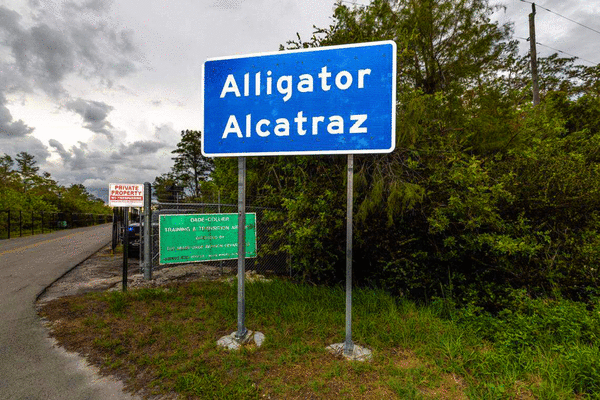
TAMPA, Fla. — In May, Florida officials announced a plan outlining to the federal government new measures to curb illegal immigration, including new detention centers.
Two months later, the state opened Alligator Alcatraz on an old airstrip inside Big Cypress National Preserve.
Homeland Security Secretary Kristi Noem praised the move, saying her department has been looking for ways to expand immigration detention space. At an October news conference in Bradenton, she said she was “grateful” for partnerships with the state of Florida, which she said help expand detention capacity while cases move through the system.
U.S. Immigration and Customs Enforcement holds detainees directly or through agreements with partner agencies. So detention centers operated by the state and federal government vary.
Florida has two state-run sites, with another planned, and five run by federal agencies or contractors. Combined, they have space for more than 10,000 people.
Some sites have empty beds, others are overcrowded. The federal government’s list of detainees doesn’t include those who are in state-run centers. ICE relies on some facilities that have a history of poor conditions.
Here’s how Florida’s immigration detention centers compare.
Alligator Alcatraz
In a video posted to his account on X, Florida Attorney General James Uthmeier was one of the first state officials to float the idea of using the site to hold immigrants. He said the camp required little investment and could open soon.
It went up in eight days, on July 1.
The U.S. Department of Homeland Security estimates running the center, operated by the Florida Division of Emergency Management, will cost $450 million annually. The state awarded no-bid contracts under an emergency declaration. Part of its funding could come from a $608 million grant request to fund immigration detention and enforcement approved by the Federal Emergency Management Agency.
Alligator Alcatraz is designed to hold up to 5,000 people. It is made up of heavy-duty tents and fenced units. At its peak in July, it held about 1,800 detainees.
It has been criticized by environmental and human rights groups and immigration attorneys and lawmakers. Alligator Alcatraz has been described as crowded, unsanitary and bug-infested. In late August, a federal judge ordered the camp to close. A three-judge panel from the U.S. Court of Appeals for the 11th Circuit in Atlanta paused that order while the appeal is reviewed, allowing the camp to stay open.
“The conditions in these facilities are both reprehensible and unconstitutional,” said Noelle Damico, director of social justice at the Workers Circle, a group that organizes vigils outside Alligator Alcatraz, now in its 13th week.
For weeks, detainees did not appear in ICE’s database, making it difficult for relatives or attorneys to find them. Records obtained by the Tampa Bay Times/Miami Herald Tallahassee bureau show hundreds of immigrants with no criminal charges were held there.
Hector Diaz, managing partner at Your Immigration Attorney, a law firm in Miami, said the state-level expansion has created numerous challenges. He said the most concerning is the lack of coordination.
“Florida has not established new immigration courts or judges to handle these cases, which effectively punishes the detainees being housed there,” said Diaz.
Deportation Depot
The second new state-run center is at the Baker Correctional Institution in Sanderson, about 40 miles west of Jacksonville. It has space for 1,300 beds, though state officials say it could expand to hold up to 2,000. It opened in September.
Giving it the memorable name “Deportation Depot” was a way of “building on the success the state has had with Alligator Alcatraz,” DeSantis said in a news release when his office made the announcement in early August. It’s 15 minutes from the Lake City Regional Airport.
Former Mexican consul in Orlando Juan Sabines said they have made a couple of trips there to check the status of Mexicans held at the site. The distance is a challenge for many families who want to visit and support detainees, he said.
Panhandle Pokey
There are few details about Gov. Ron DeSantis’ plan to open a third detention center in the Panhandle.
During a visit to Panama City, the governor said law enforcement officials told him that transporting detainees to Alligator Alcatraz or even to the Deportation Depot in North Florida can take hours, depending on their location in the Panhandle.
“You know, you’re in the Panhandle sending to Alligator Alcatraz, that’s a long way,” DeSantis said. “Even sending to the Deportation Depot in North Florida, that could be three to five hours depending on where you are in the Panhandle.”
DeSantis said the state is working to set it up.
Krome North Service Processing Center
Krome, a federal center designed to hold about 600 people, has an average daily population of 769 detainees. In September, it was holding about 900, according to data from Syracuse University’s Transactional Records Access Clearinghouse. Krome at one point housed 1,806 detainees, nearly three times its intended capacity.
Conditions reflect the strain; videos on social platforms such as TikTok showed people sleeping on the floor. In June, a group of Cubans protested their detention by spelling out “SOS” with their bodies on the ground.
Immigrants held at Krome and groups such as Human Rights Watch say medical care is often delayed. More than 170 calls were made to 911, double the number from the same period last year, according to a review by The Tributary, an online news organization.
Setareh Ghandehari, advocacy director at Detention Watch Network, said they’ve heard reports of poor conditions and abuse in Krome and other facilities.
Between January and September, three people detained at Krome died in local hospitals, according to Immigration and Customs Enforcement. In October, an immigrant from Jordan died in a hospital after being in custody at Krome.
“That’s too many deaths in less than one year,” said Ghandehari.
There were 26 deaths during the four years of the Biden administration, Ghandehari said. They’re almost at that number in just one year.
A spokesperson for U.S. Immigration and Customs Enforcement said in an email to the Times that all detainees at Krome and other detention centers under the agency’s oversight are well cared for and can communicate with their families and lawyers.
“Every individual booked in custody is provided with a bed. Proper facility conditions are ensured through thorough inspections, and any claims otherwise are false,” said the spokesperson.
Baker County Detention Center
The center, just west of Jacksonville in Macclenny and run by the Baker County Sheriff’s Office, has long faced allegations of poor conditions and mistreatment. The American Civil Liberties Union of Florida and Sanctuary of the South filed a lawsuit in May on behalf of an immigrant who spent 88 days in solitary confinement in 2021.
Last year, a former medical worker (whistleblower) confirmed ongoing abuse. There’s also a separate federal lawsuit on behalf of a 33-year-old Colombian woman.
As of Nov. 10, it held 288 people, exceeding its guaranteed minimum of 250, according to Syracuse’s tracker.
Glades County Detention Center
In April, immigration authorities expanded detention capacity through Glades County Jail in Moore Haven, west of Lake Okeechobee.
The jail has 500 beds but had 463 detainees in Nov. In March 2022, under the Biden administration, ICE ended its contract with Glades over persistent concerns about detainee medical care and other issues.
Broward Transitional Center
This Pompano Beach federal center is run by a private company, GEO Group, and has a contract for at least 700 beds. Recent data shows an average daily population of 668 detainees. A Human Rights Watch report cited it, as well as Krome and the Miami Federal Detention Center, for abuses.
In April, a Haitian woman held there died in a local hospital. U.S. Reps. Sheila Cherfilus-McCormick was among those who visited the site and said she saw no evidence of proper procedures or adequate health care.
Federal Detention Center Miami
This center has faced scrutiny from immigration attorneys and advocates over limited access and overcrowding.
The building, in downtown Miami, is operated by the Federal Bureau of Prisons. In May, an employee told the Miami New Times there were about 500 detainees. Last month, there were 465, according to Syracuse’s database.
©2025 Tampa Bay Times. Visit at tampabay.com. Distributed by Tribune Content Agency, LLC.






Comments