The life of a Christmas tree
Published in News & Features
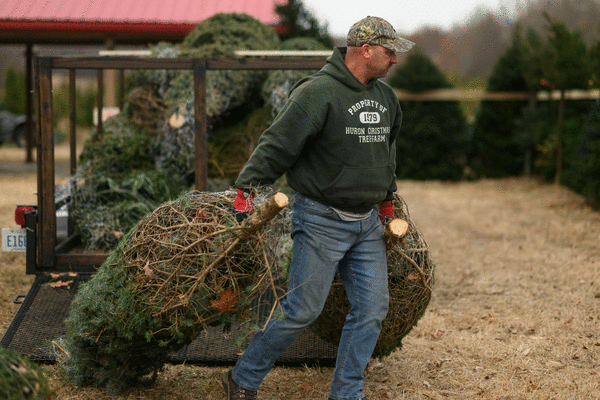
One common argument we hear against having a natural Christmas tree is the misconception that the trees are cut down from the forest then hauled away to market. The belief is that fewer trees are left to help capture carbon dioxide from the atmosphere.
What actually happens is that Christmas trees are grown as a harvestable farm crop much like wheat, corn or vegetables. It’s just that this crop takes more than one growing season to be ready for harvest.
The typical lifespan of a Christmas tree is around seven to 10 years, and the evergreen goes through different stages during its life to eventually become a Christmas tree. The tree begins its life as a seed inside a pine cone. Each scaly section of a cone usually contains two seeds. Seeds separated from the cone by growers are planted into high-density growing beds at a rate of around 50 tree seedlings per square foot. They are grown in those beds for one to three years and are cared for by weeding, fertilizing, irrigating and protecting them from pests and diseases.
When large enough, the seedlings are lifted from the beds, graded, packed and sold to Christmas tree growers as bareroot seedlings. Some are transplanted to lower density growing beds where they can spend another year or two. An even smaller number are transplanted into containers.
The Christmas tree grower then transplants the seedlings into prepared fields. The first two or three years are devoted to keeping the young trees alive and healthy. The grower also makes sure each tree has a single trunk by pruning out any extra leader stems. By the third year, the trees speed up their growth and will grow into spindly trees if left on their own. At that time, they need to be pruned.
Each growing season your Christmas tree grew a new set of branches, called a whorl. So if you look at your Christmas tree, each whorl represents one year of growth. Pruning and shearing slows down growth, resulting in bushier trees with shorter distances between each whorl. While both techniques remove plant material, pruning is different from shearing. In pruning, individual pruning cuts are made to remove extra growing tips (the part where your Christmas star goes) or dying branches, very low branches and unusual growth.
Shearing involves shaping the tree into a cone shape, similar to shearing a backyard hedge, and it is the most critical part of Christmas tree growing. Without shearing, it would end up being a sad-looking, limp tree like the one featured in a beloved TV Christmas special. Workers walking down each row shear the trees by hand using special 3-foot-long shearing knives.
Depending on the species of Christmas tree, shearing happens during mid-summer or during late fall to mid-spring. Trees are sheared each year until they reach the desired height for market, usually around six to eight years for a 6-foot-tall tree.
After the trees are harvested and gone from the field, more Christmas tree seedlings are planted to continue the crop cycle.
______
©2025 The Detroit News. Visit detroitnews.com. Distributed by Tribune Content Agency, LLC.






Comments