The DOJ is still hiding the names of Epstein's co-conspirators
Published in News & Features
The FBI was looking into at least 10 of Jeffrey Epstein’s “co-conspirators” in 2019, new documents released Tuesday revealed for the first time, but the Department of Justice blacked out many of their names without explanation or justification.
The continued withholding of information — particularly about those who witnessed, participated in or aided Epstein’s crimes — drew outcry from lawmakers on Tuesday.
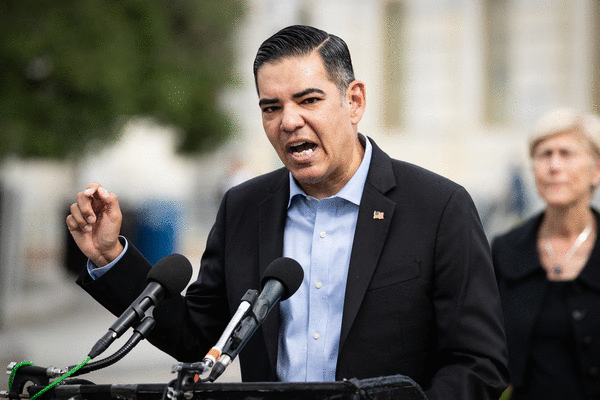
“Who are Epstein’s co-conspirators? Why are they making illegal redactions?” asked Robert Garcia, House Oversight Committee ranking Democrat, in a statement Tuesday.
Three of the names that were not redacted: Ghislaine Maxwell, who was convicted of sex trafficking a minor in 2021; Jean-Luc Brunel, a French modeling scout who committed suicide in prison while awaiting trial in 2022; and Les Wexner, the billionaire retailer and former owner of Victoria’s Secret accused of being one of Epstein’s clients.
The DOJ redacted at least seven names in one 2019 email discussing co-conspirators.
Republican Rep. Thomas Massie said in a statement to the Miami Herald that “a complete disclosure consistent with the Epstein Files Transparency Act will reveal more men should be investigated for sex crimes.”
A separate 2024 FBI memo released Tuesday states that “multiple individuals associated to Epstein” were subpoenaed in 2019, including Maxwell, Brunel, two pilots whose names were redacted by the DOJ, a “chief engineer” whose name was redacted and six others whose names were also blacked out.
The new Epstein transparency law requires the DOJ to provide justification for all redactions within 15 days after their release. The DOJ has not yet published these justifications, and did not respond to questions from the Miami Herald about why it chose to black out co-conspirators’ names.
On Friday, Deputy Attorney General Todd Blanche wrote a letter to Congress saying that the department was making additional redactions beyond those outlined in the law. Blanche said the department also redacted information under “various privileges” such as “attorney-client privilege” and “work-product privilege.”
Over the decades, Epstein used several young women to help him recruit victims, schedule them for sex and make travel arrangements. It’s not clear how many of those assistants were considered “co-conspirators” in 2019. At least two of his assistants in Florida, previously identified in public documents, have said that they too were victims.
The Department of Justice released more than 10,000 new records in response to a law forcing the release of all of its files related to Epstein. The documents appeared to continue the DOJ’s pattern of withholding information in the records beyond the scope of the Epstein Files Transparency Act.
One of the newly released documents was an email from someone identified as being from the FBI in New York asking for an update on the status of “10 CO conspirators” in 2019.
A respondent — whose name was removed by the DOJ — wrote that there was attempted contact with “Brunel,” and also discussed attempts to contact “Maxwell” and “Wexner,” the 88-year-old founder of L-Brands who for years was Epstein’s only known client. Wexner has claimed that he broke off all ties with Epstein in 2007 after discovering that his one-time investment manager had bilked him out of almost $50 million.
Wexner has denied any knowledge of Epstein’s crimes. Virginia Giuffre, who was interviewed extensively by the Herald in 2018, 2019 and 2020, said that she was directed by Epstein to have sex with Wexner. Last year, a spokesman for Wexner denied he had ever met Giuffre and said he was never involved in “any of the abhorrent behavior engaged in by Epstein.” Giuffre died by suicide in April.
In 2005, Epstein was accused of running a sex-trafficking operation in South Florida involving more than three dozen underage girls. The case was turned over to the FBI and prosecutors in the Southern District of Florida.
As the Miami Herald documented in its 2018 ‘Perversion of Justice’ investigation, Epstein reached a remarkably lenient deal with federal prosecutors in South Florida in 2007 that allowed him to plead guilty to two state prostitution charges, one involving a minor, and serve 13 months in the Palm Beach County Jail, where he was allowed to leave regularly to work from a nearby office space in which he continued to abuse girls.
That series led federal prosecutors in the Southern District of New York to reopen that case in 2018, and Epstein was arrested on sex trafficking charges in July 2019.
One 2019 letter sent by SDNY prosecutors detailed two wire payments made to individuals prominently featured in reporting by the Miami Herald. The attorneys listed the recipients of these funds as “potential co-conspirator[s]” in 2019.
The letter is referring to Epstein’s 2007 non-prosecution agreement, or plea deal, that gave him and four of his female assistants immunity from federal prosecution. All four of the women were named in the original document that was made public, in 2009, but their names are now redacted from the DOJ’s memos about the deal.
The letter refers to two payments, one for $100,000 and another of $250,000, that Epstein sent to two of those same assistants in early December 2018.
_____
(Miami Herald reporters Ana Claudia Chacin, Shirsho Dasgupta, Claire Healy and Churchill Ndonwie contributed to this report.)
_____
©2025 Miami Herald. Visit miamiherald.com. Distributed by Tribune Content Agency, LLC.






Comments