Chicago Mayor Brandon Johnson surrenders budget fight, will not veto opponents' package
Published in News & Features
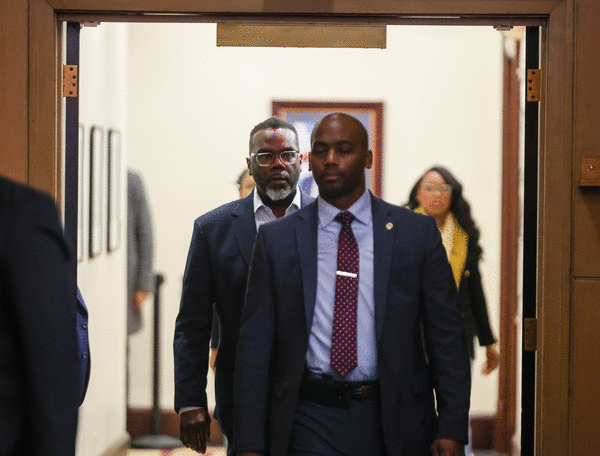
CHICAGO — Mayor Brandon Johnson announced Tuesday he will not veto the 2026 budget passed by aldermen, conceding a historic struggle that reached the brink of a government shutdown and burned his goodwill with the City Council.
Speaking to TV cameras from his ceremonial office, Johnson confirmed he will not veto the $16.6 billion counterproposal to his spending plan for next year, despite his ongoing objections to his council rivals’ package. His decision comes days before the end-of-year deadline to either finalize a budget or imperil vital city services as well as tens of thousands of paychecks.
His communications director Erin Connelly confirmed to reporters, “The budget will go into effect without his signature. He will not be affirming the budget with his signature.”
But in an attempt to block his political foes from having the last word, Johnson also signed a series of executive orders, one aimed at upholding police overtime restrictions undone by aldermen, the other to ban the sale of medical debt, such as ambulance rides, to balance the city’s budget.
He framed the move as him standing up to his obstinate council counterparts, though implicit in his announcement was him permitting the rest of the alternate budget to go through.
Johnson’s surrender reflected not just concerns about the fallout from a shutdown, but also his diminished standing over the City Council, which passed a budget over the mayor’s objections for the first time in four decades.
The opposition bloc led by moderates, including his own Finance Committee chair, appeared far closer to a 34-vote veto-proof margin than he was to a 26-vote simple majority — or 25, for a tie-breaker — and members of that group expressed confidence that if Johnson did strike down their package they would override him.
Throughout hours of floor speeches on Saturday, aldermen across the city’s political spectrum blamed him for how the 2026 budget fight grew so unmanageable and caustic. Then they voted 30-18 on the remainder of the spending package, after a 29-19 vote on a revenue package that cuts out Johnson’s corporate head tax. That was the cornerstone of the mayor’s budget proposal unveiled mid-October, one that he sought to tie to his larger “tax the ultra-rich” agenda but which consistently failed to sway a majority of City Council.
The mayor has argued the alternative plan relies on faulty assumptions that ultimately make it unbalanced, including a “morally bankrupt” plan to sell to debt collectors $1 billion in long-outstanding money owed to the city for pennies on the dollar. During a lengthy floor speech before Saturday’s vote, he admonished his opponents for placing the responsibility of this budget fight “on one person” and implored them to “not pick and choose” who wears the jacket.
Still, Johnson ruling out a veto signaled he understood the political implications of crossing that line.
His closest ally, the Chicago Teachers Union, delivered an implicit message Saturday that he can, and should, claim victory.
“We fought for a budget that puts people first and we won,” the CTU wrote in a statement after the vote. “The Corporate Caucus tried to force cuts that would’ve hurt working families. But our organizing made them back down. … That’s more than we’ve won in a budget fight in years.”
So ends the mayor’s third budget process. Left in its wake are a City Council undergoing a generational political realignment, a mayor’s office increasingly isolated on the fifth floor of City Hall and a budget plan all sides admit is imperfect.
The next task at hand, Johnson’s budget chair Ald. Jason Ervin had said Saturday, is amending parts of the counterproposal that never got smoothed out during the hectic timeline of the last several weeks.
The budget that passed contains a mix of untouched Johnson proposals — which his allies have been celebrating as a victory — as well as slight tweaks to his original plan and wholesale revenue changes.
Much of Johnson’s original proposal is fully intact. That includes a $1 billion tax-increment financing surplus to yield $572 million for Chicago Public Schools and $233 million for the city; short-term borrowing to cover the cost of back pay for Chicago firefighters and legal settlements and borrowing plans for infrastructure improvements.
The city’s tax on personal property leases, which applies to everything from car rentals to cloud computing, goes up from 11% to 15%, while the congestion zone for ride-share trips on Uber and Lyft is expanding.
The head tax is gone. There is no major property tax hike either, save for a $9.1 million increase dedicated to averting cuts at the city’s libraries, nor a hike in garbage fees that the opposition bloc initially floated.
And the alternative budget restores the full advance pension payment, which Johnson’s original proposal had cut by roughly half. The revenue plan relies on a constellation of new taxes and raised fees that Johnson did not initially pitch, such as virtual and traditional advertising on city property, major changes to liquor taxes and legalizing video gambling across the city.
The mayor’s team has fixated on the counterproposal’s sale of $1 billion in debt for an estimated $90 million as an immoral plan that would “harass” poor Chicagoans with private debt collectors and not raise any dollars at all.
Avoiding a government shutdown diminishes the risk of a ratings downgrade, but experts have said based on recent trades, buyers of Chicago debt are already expressing their doubts. And all corners of City Hall agree: what transpired the last few months hardly solves the city’s intractable fiscal issues that could portend an even tougher budget fight for 2027 — when an election looms.
Still, whatever happens next for Johnson’s waning power over City Council, he appears resolute that his moral high ground has not diminished one bit.
Minutes before his Tuesday news conference began, the mayor’s X account shared a headline titled, “Is it ethical for the city to use private debt collectors?”
His one-word response? “No.”
____
©2025 Chicago Tribune. Visit at chicagotribune.com. Distributed by Tribune Content Agency, LLC.




Comments