Some Illinois hospital systems won't participate in medical aid-in-dying, which is allowed under a new law
Published in News & Features
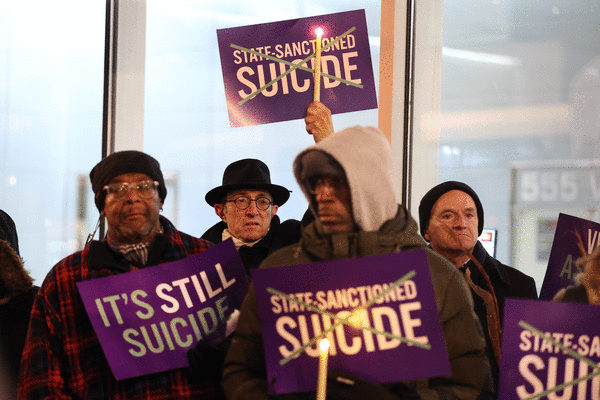
CHICAGO — Though a new Illinois law allows doctors to help terminally ill people end their lives, several Illinois health systems with religious affiliations say they will not participate.
OSF HealthCare, Ascension and Hospital Sisters Health System all say they will not take part in medical aid-in-dying.
The new law, which sparked controversy and barely passed the Senate during the fall legislative session, specifically does not force health care professionals or health care organizations to help people end their lives.
In fact, the law allows health care organizations to prohibit health care professionals, staff, employees and independent contractors from practicing aid-in-dying care while performing duties for the organization.
“OSF HealthCare is saddened to hear that Governor Pritzker signed SB 1950 into law,” the system said in a statement. “As a Catholic health ministry, OSF is guided by honoring the dignity of every human person and we will not participate in or support any form of physician-assisted suicide. These practices are fundamentally inconsistent with our Mission to serve with the greatest care and love.”
OSF HealthCare has 16 hospitals in Illinois, including OSF HealthCare Little Company of Mary Medical Center in Evergreen Park.
Ascension is also a Catholic organization and has several hospitals in the Chicago area, including Ascension Alexian Brothers in Elk Grove Village, Ascension St. Joseph in Chicago and Ascension St. Alexius in Hoffman Estates.
As a Catholic organization, Ascension abides by the Ethical and Religious Directives for Catholic Health Care Services, a spokesperson said in a statement.
“We provide loving care, psychological and spiritual support, and appropriate remedies for pain and other symptoms that allow our patients to live with dignity until the time of natural death,” according to the statement.
The law requires health care organizations that don’t participate in medical aid-in-dying to refer patients who request help to different health care professionals or organizations that can assist.
Ascension said in its statement it will comply with the legal requirements related to opting out of participation.
Hospital Sisters Health System also said in a statement that it is “deeply disappointed” that the medical aid-in-dying bill was signed into law. The system is based in Springfield and has 10 hospitals in central and southern Illinois. The State Journal-Register previously reported on the system’s decision not to participate in the new law.
“As a Catholic health care system, HSHS upholds the sacredness of life from conception to natural death and is unwavering in our position not to participate in or condone any action intended to hasten or cause death,” the system said in a statement.
Advocate Health Care, which is also religiously affiliated, is “reviewing this policy,” a spokesperson said in an email. A representative for Loyola Medicine did not respond to requests for comment Thursday and Friday.
The measure faced significant opposition from religious groups and disability rights activists as it made its way through the legislature. Opponents worried that terminally ill people might be coerced to end their lives, and they also expressed concerns about discrimination and abuse.
Proponents, however, argued that people with terminal illnesses should have the autonomy to decide when to die.
Under the new law, which takes effect in September, patients must be at least 18 years old, have the mental capacity to make medical decisions and have an incurable disease that will likely lead to their death within six months, in order to get medical aid-in-dying.
The patient would verbally ask their attending physician for a prescription for medication to help them die, and then submit a written request to the doctor, witnessed and signed by two people who can attest that the patient is mentally competent, asking voluntarily and not being coerced. The patient must then make another oral request to the doctor no sooner than five days after the first request.
An attending physician must also give the patient information about other end-of-life care options such as comfort care, hospice care and palliative care and pain control.
Illinois is one of at least 11 states that now allow medical aid-in-dying. New York Gov. Kathy Hochul recently announced that she’d reached an agreement with that state’s legislature to pass and sign a bill in January allowing medical aid-in-dying in New York.
_____
©2025 Chicago Tribune. Visit chicagotribune.com. Distributed by Tribune Content Agency, LLC.






Comments