Chicago Mayor Brandon Johnson calls aldermen's debt sale plan a 'red line,' yet mum on budget veto
Published in News & Features
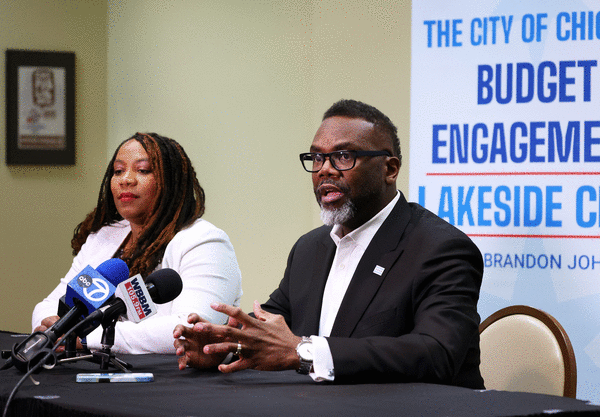
CHICAGO — Mayor Brandon Johnson on Thursday singled out a debt collection measure as his latest nonstarter in the budget proposal crafted by his aldermanic antagonists, who showed no signs of slowing their march toward an imminent final vote.
Following a City Council meeting where aldermen teed up their 2026 spending package for potential passage Saturday, the mayor told reporters it contains a major component he would not accept because it would hurt poor Chicagoans.
The plan to raise about $90 million by selling debt owed to the city would not only “result in debt collectors harassing residents who have fallen behind on some of their bills,” but was completely speculative, he said, because there’s no guarantee there would be buyers.
“Yes. Yes. I mean, in very certain terms, yes,” Johnson said when asked if that part was a deal breaker. “I’m Gen Xer, right? There’s nothing more disturbing and troubling than someone inviting you on a road trip, and you don’t have a full tank of gas.”
But asked whether he would veto a budget that included the debt sale, the mayor demurred: “I’m saying that as long as that is the approach, then we have to keep talking and … working towards a reasonable compromise.”
“The means and the practices that they use in order to collect the debt are quite severe. And I know that firsthand,” said Johnson, who as a mayoral candidate drew scrutiny for owing more than $3,000 in water and sewer bills to the city before announcing he would pay them off during the runoff.
Meanwhile, the group backing the alternative proposal rejected the mayor’s analysis and showed no signs of slowing down. Leaders of the aldermanic bloc said they have a council majority and expect to vote on their plan Saturday as the city gets closer to an end-of-year deadline.
“This coalition doesn’t need to play games,” Ald. Brendan Reilly, 42nd, told reporters after the brief council meeting. “If the mayor chooses to veto this budget, that’s his decision, but he’s the one pushing us to the brink.”
And to justify the debt plan, Ald. Gilbert Villegas, 36th, said it will be up to Johnson to make sure the plan does not target poor people.
“We have billions of dollars of unpaid debt. The city government needs to make a decision. Are we going to collect this debt or not?” Villegas said. “There’s other people that can afford to pay that we haven’t targeted.”
In their plan, the city would sell $1 billion in long-uncollected debt owed to the city for $89.6 million. That high-dollar estimate makes the proposal the largest piece of the alternative group’s plan to balance the city’s budget. And it’s a striking contrast to Johnson’s proposed employee head tax on larger corporations, which he’s counting on to raise $82 million in a budget the council has apparently rejected.
Johnson’s team has repeatedly argued the novel tactic is untested and should not be relied upon in a budget, even though members of the administration reportedly explored the idea earlier this year. And if it were implemented, the “morally bankrupt” maneuver would lead to debt collectors aggressively targeting poor people and working-class people, the mayor said Thursday.
The debt collection controversy was the latest in a long-winding negotiation process over Chicago’s 2026 budget. Complicating this year’s budget fight for Johnson was his public threat of a mayoral veto last month after suffering a stinging loss in the Finance Committee over the head tax. He drew specific lines against a hike in property taxes or garbage fees, or a grocery bag levy.
Johnson spokesperson Cassio Mendoza said after the mayor’s news conference Thursday that the administration plans to propose alternatives to the debt plan and is likely to rely on a number of small measures to attempt to fill its $90 million spot in the budget.
The fracas could drag on even if a budget passes Saturday, according to Ald. Jason Ervin, 28th, a top Johnson ally who chairs the critical Budget Committee.
After Thursday’s meeting, Ervin said negotiations might need to continue beyond a vote in coming weeks to amend any spending plan because Johnson’s team still possesses broad discretion over how any new policies would be implemented. It was a nod toward a potential point of mayoral leverage as the alternative group tries to finally outmuscle Johnson.
“Without the buy-in of the executive branch, this is a setup for failure, and that failure is going to impact our citizens,” Ervin said. “The executive branch does have the ability to not do things, and I think that’s the part of government that we sometimes don’t even think about.”
©2025 Chicago Tribune. Visit chicagotribune.com. Distributed by Tribune Content Agency, LLC.






Comments