US admits fault in deadly plane crash that killed 67 above DC
Published in News & Features
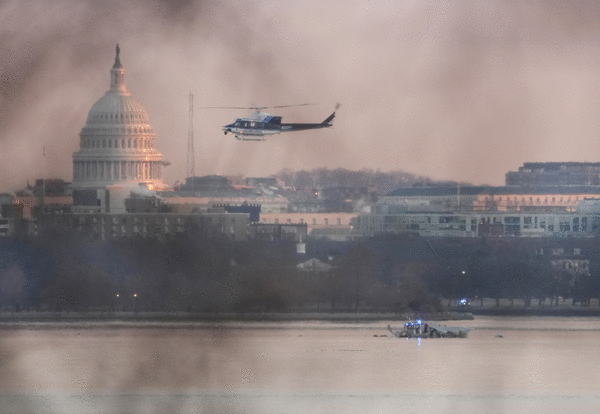
Calling the event a “wholly avoidable tragedy,” the U.S. government on Wednesday admitted liability in the fiery crash over the Potomac River that occurred early this year when a plane from Wichita, Kansas, to the nation’s capital collided with an Army helicopter.
The admission came in a document filed Wednesday in federal court in a lawsuit brought by the widow of one of the victims. The government’s admissions were included in its responses to the allegations raised in the lawsuit.
“The United States admits that it owed a duty of care to Plaintiffs, which it breached, thereby proximately causing the tragic accident on January 29, 2025 … ” the Justice Department wrote in what was called a “general admission of liability.”
The admission means that the plaintiff is legally eligible to recover monetary damages, the government said.
American Eagle Flight 5342 from Wichita to the Ronald Reagan Washington National Airport was on final approach to land on Runway 33 when it collided with an Army Black Hawk helicopter over the Potomac River at about 8:48 p.m., exploding on impact and plunging into the icy water. The plane had 60 passengers and four crew members on board, and the helicopter was carrying three soldiers.
There were no survivors. Among the victims were elite young figure skaters who, with their families and coaches, had been in Wichita for the U.S. Figure Skating Championships and a national development camp.
The wrongful-death lawsuit was filed Sept. 24 in the U.S. District Court for the District of Columbia by Rachel Crafton on behalf of Casey Crafton, who died in the crash. It named as defendants American Airlines, its subsidiary PSA Airlines and the United States.
In its 209-page response, the government also admitted that the airspace near the airport “is busy at times and the risk of midair collision cannot be reduced to zero in the National Airspace System, generally, and specifically during approaches to DCA … ”
It acknowledged “that pilots have reported, and radar and other data confirms, that aircraft have come into close proximity to other aircraft within the Class B airspace near DCA on certain occasions.”
In its filing, the government said the helicopter crew was required “to maintain vigilance so as to see and avoid other aircraft, including AE5342 and maintain situational awareness, including along its intended path of flight.”
“The United States further admits that the PAT25 pilots should have maneuvered to avoid colliding with AE5342.”
But the government said that the plane crew should have been more aware as well.
“The United States admits that the AE5342 and PAT25 pilots failed to maintain vigilance so as to see and avoid other aircraft, and as a result of government employee negligence, plaintiff, if legally eligible, may recover certain monetary damages from the United States … ” the filing said.
The government acknowledged that while the air traffic controller let the helicopter crew know that the plane was nearby, the controller also should have notified the pilots of the plane that they were heading toward the helicopter. The government denied, however, “that any alleged negligence of air traffic controllers on position in the Washington Tower during the accident” was a cause of the crash.
The National Transportation Safety Board is continuing to investigate the crash. In March, the NTSB issued a preliminary report and an “urgent safety recommendation” to ban helicopter traffic near the airport when certain runways were in use for arrivals or departures. Transportation Secretary Sean Duffy agreed to put the recommendation in place.
Among the NTSB’s findings were that one air traffic controller was working two positions in the tower the night of the crash and that the pilots of the aircraft might not have heard some of the calls from the tower.
In addition, the NTSB found that between October 2021 and December 2024, there had been 15,214 occurrences between commercial airplanes and helicopters in which the aircraft were within one nautical mile of each other with a vertical separation of less than 400 feet. The investigation also found that there were 85 recorded events that involved a lateral separation less than 1,500 feet and vertical separation less than 200 feet.
A final NTSB report is expected to be released early next year.
_____
©2025 The Kansas City Star. Visit kansascity.com. Distributed by Tribune Content Agency, LLC.




Comments