Auto review: At the helm of the giant, remade VW Atlas
Published in Business News
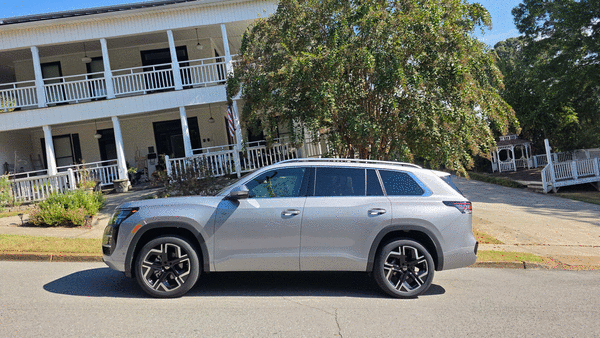
HUNTSVILLE, Alabama — The second-generation, 2027 Volkswagen Atlas is big. How big? My 6-foot-5-inch frame and 6-foot-7-inch Atlas Product Manager Jim Burch both fit easily in the third row.
Together.
We make things big in America. Big people, big attractions, big cars. For years, Volkswagen sent too-small, too-expensive German-made vehicles like the Touareg to the U.S. In 2018, VW finally got the memo and produced the Made-in-America, three-row Atlas large SUV. Not just any large SUV, but one of the biggest in class. Big proportions, big interior, big V-6, big value. It sold big, instantly becoming the second-best-selling V-dub in the lineup after — you guessed it — another roomy SUV, the Tiguan.
For its gen-two sequel, Atlas goes even bigger. Complementing its proportions, it gains a bucket-list of tech, premium appointments and standard features.
This thing has every standard feature in the book.
Twin wireless chargers? Check.
Magnets to hold phones in place? Check.
Adaptive cruise control? Check.
Blind-spot assist? Check.
Wood trim? Check.
Heated/cooled front seats? Auto rain-sensing wipers, auto high beams, auto tailgate, digital instrument/infotainment displays, wireless Apple CarPlay/Android Auto, heated steering wheel, leatherette seating, park distance control, seven USB-C ports, rear sunshades? Check.
Rear shower and bath? Now I’m pulling your leg.
I only wish this sporty brand had gone bigger with more powertrain and all-wheel-drive options.
On an 80-mile day trip to Guntersville City Harbor on the Tennessee River in Alabama, I squeezed my loaded, all-wheel-drive, $58,135 R-Line Premium tester through suburban neighborhoods, floored it across country roads, cruised it on adaptive cruise control on highways.
With over 500 miles of range, I never looked at the gas gauge, never worried about fueling. Had this been the 300-mile family round trip (we Paynes like road trips) from Atlanta-to-Guntersville with my wife and Atlanta-based son/daughter-in-law/grandson, it would have been similarly effortless — not to mention comfortable with the Atlas’ palatial interior, cargo space, easy-to-access third row, child-seat-friendly back seats and improved interior design.
Exterior changes are conservative — it’s the interior that got the second-gen love. Check out the clever, concealed, pull-up door openers at the end of the door armrests. Sculpted cupholders. Intuitive infotainment menu.
Or one of the roomiest consoles in the game thanks, in part, to a steering-column-based shifter that frees up the console for those aforementioned magnetic phone chargers and a sub-console space to store Mrs. Payne’s purse.
Only the hated START-STOP remains untouched — a nanny state feature unnecessary after recent EPA emissions deregulation.
Packed into Atlas, the Paynes would have looked forward to a day of getting ice cream at Kilwin’s in City Harbor, strolling the boardwalk, detouring to Cathedral Caverns.
But ...
Had we been driving the Atlas’ electric, three-row, all-wheel-drive $70K ID.Buzz sibling with 180 miles of (real-world) range, it would have been a different story. Range-anxiety, long charging times, maybe no caverns.
Who killed VW’s electric-vehicle revolution? Its own internal-combustion vehicles.
Just two years after the brand’s massive investment in the ID.4 and ID.Buzz EVs in the U.S. market, they are gone, victims of consumer disinterest. Compared to the cheaper, more capable Atlas’ 70,000 annual sales, ID.Buzz sold just 6,140 units in 2025.
The Atlas knows its American customer; the ID.Buzz — like, ahem, VW’s old Touareg — did not. While VW was distracted by the EV mirage, the competition jumped ahead on off-road trims and engine upgrades.
Take the off-road trend sweeping the three-row SUV segment with lifted suspensions, rugged grilles, all-terrain tires. All the cool kids are doing it. Kia Telluride X-Pro, Hyundai Palisade XRT Pro, Ford Explorer Tremor, Chevrolet Traverse Z51, Honda Pilot TrailSport, Toyota Grand Highlander Woodland, GMC Acadia AT4, Nissan Pathfinder Rock Creek.
These models are flying off shelves. VW says it got the memo — but has other priorities in mind.
Namely that the Wolfsburg, Germany-based brand is on-road focused — a road warrior defined by corner-carving hellions like the Golf R, Golf GTI and Jetta GLI. True enough, on twisted country roads on my drive south to Guntersville, the 4,600-pound Atlas was surefooted.
But on-road-focused competitors like the three-row Mazda CX-90 and Dodge Durango back up their sure-footed chassis with stonkin’ engine choices. Think a smooth, 340-horsepower, 3.0-liter straight-6 cylinder engine in the CX-90. Or a choice of 360-horsepower 5.7-liter, 475-horse 6.4-liter, and 710 horsepower supercharged, 6.2-liter Hellcat V-8s in the Durango. Huzzah.
The V-dub’s only option? A 2.0-liter, 282-horse variant shared with its compact cars. Oh.
Exiting a switchback turn, I nailed the throttle and Atlas groaned as if to say: how can I put the world on my shoulders with this 4-banger?
Other competitors (Mazda, Kia, Hyundai, Toyota) include sippy hybrid models. VW has received that memo with a hybrid Atlas on the way a couple of years.
Speaking of trends, Detroit automakers have jumped into the three-row space with hands-free driving tech available with a subscription ($40 a month for Chevy, $50 a month for Ford). These systems make road trips less fatiguing, but Atlas stays hands-on.
On Alabama Route 431, I thumbed adaptive cruise control and set my speed to 70 MPH. Hands-free will have to wait.
Wolfsburg has a different subscription model in mind.
Air Console is an in-car computer gaming console that turns the infotainment screen into a multi-player game with up to eight smartphones as controllers. I played Pac-Man. I suspect my Nintendo Switch-playing family of gamers will stick to their own consoles rather than paying VW’s $150-a-year fee (after a three-year free trial that includes Wi-Fi and enhanced AI navigation features).
With its laundry list of standard features, big interior volume, and adult-friendly third-row seat, the Atlas’s favorite trim for my money is the standard SEL. At $43,500, the front-wheel-driver boasts standard features you’d have to opt for the $45,725 Kia Telluride EX trim to match.
It’s a throwback to the affordability theme that made VW a household name in the 1960s with the thrifty Bug. Seventy yeas later, that practicality is back in a hulking, three-row SUV.
Made in America for big Americans.
2027 Volkswagen Atlas
Vehicle type: Front-engine, front- and all-wheel drive, 6-or-7-passenger SUV
Price: $43,135 including $1,525 destination charge ($58,135 SEL Premium R-Line as tested)
Powerplant: 2.0-liter turbo-4 cylinder
Power: 282 horsepower, 258 pound-feet torque (turbo-4)
Transmission: 8-speed automatic
Performance: 0-60 mph, N/A; towing, 5,000 pounds
Weight: 4,568 pounds (as tested)
Fuel economy: EPA 22 city/ 29 highway/ 25 combined (FWD), 20 city/ 27 highway/ 23 combined (AWD); range, 539 miles (FWD)
Report card
Highs: Roomy SUV; healthy standard features
Lows: Lacks engine options; air console gimmicky
Overall: 3 stars
____
©2026 www.detroitnews.com. Visit at detroitnews.com. Distributed by Tribune Content Agency, LLC.










Comments