Fed seen hiking rates in defiance of Trump: Decision-day guide
Published in Business News
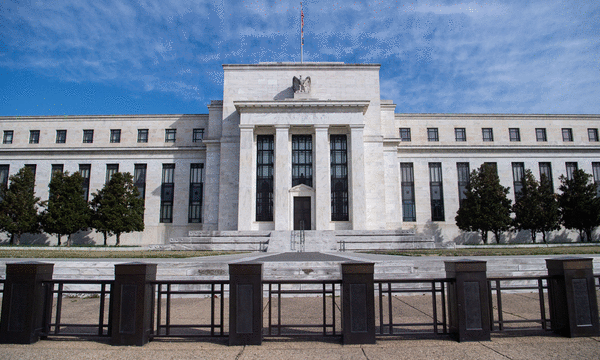
The Federal Reserve is expected to lift interest rates on Wednesday for the first time since 2023 as policymakers lose confidence that inflation will cool sufficiently without at least a nudge from the central bank.
That’s likely to strain Chairman Kevin Warsh’s relationship with President Donald Trump.
Officials have held their benchmark rate steady in a range of 3.5%-3.75% since December as a majority of policymakers argued that progress in lowering inflation was being stalled by temporary factors.
Doubts over that stance have grown steadily this year within the Fed, and a recent hot inflation report appears to have tipped the scales in favor of at least one near-term rate increase. Investors on Tuesday saw a greater than 90% chance of a quarter-point move this week and priced in another hike by the end of the year.
“At some point they have to raise interest rates,” said Sebnem Kalemli-Ozcan, a professor of economics at Brown University. “And, actually, the more this is kicked down the road, the more inflation is going to be persistent and the bigger a problem it is then.”
The Fed will release a post-meeting statement at 2 p.m. Wednesday in Washington, together with updated economic forecasts and rate projections. Warsh is scheduled to hold a post-meeting press conference 30 minutes later.
White House worries
A rate hike could provoke fresh criticism from the White House. As recently as Sunday, Trump repeated his argument that the U.S. should have the lowest borrowing costs in the world.
The president has significantly toned down his attacks on the Fed since he appointed Warsh to replace Jerome Powell as chair. He even suggested Warsh was being pressured to raise rates by other Fed officials, whom he accused of being “very political.”
But Warsh made clear in a late August speech that underlying price pressures hadn’t meaningfully improved, and the Fed had “work to do” if it didn’t receive new assurances that inflation was on a path to the central bank’s 2% target.
Two weeks later, data showed core inflation — which excludes food and energy — rose more than expected in August. Though much of the increase was driven by a record spike in wireless telephone services, many analysts said the Fed couldn’t ignore the report after missing its 2% goal for more than five years.
Press conference
Warsh’s comments will be closely scrutinized when he takes questions from the reporters. At his post-meeting appearance on July 29, he failed to offer a clear explanation for the Fed’s decision to hold rates and provided little insight into his views on the economy. That prompted a jump in long-term bond yields and a wave of criticism from traders and economists.
Yet, the chairman’s speech in Jackson Hole, Wyoming, last month appeared to quell investors’ concerns. A rate hike on Wednesday could further repair any lingering damage.
Reporters are likely to again press the chairman for an explanation of the committee’s decision and push for any hint that one rate increase might mark the beginning of a hiking cycle. While he’s unlikely to offer a clear signal on the future path of rates, Warsh could again frustrate investors if he resists sharing his views on where the economy stands now.
Dissents possible
Concerns have been mounting within the Fed all year that a series of seemingly temporary factors, including tariffs and the war in Iran, risked embedding high inflation in the public’s expectations.
Three officials dissented at the Fed’s July meeting in favor of higher rates. A hike at this gathering could also be backed by several colleagues who indicated prior to the August inflation report that they required an improvement in price data to continue holding policy steady.
But a unanimous decision isn’t assured. Governor Christopher Waller has given mixed signals on his read of inflation, and New York Fed chief John Williams said earlier this month there was still evidence that disinflation was on the way. Several economists also predicted Vice Chair for Supervision Michelle Bowman, who is seen as closely aligned with the White House, might dissent in favor of holding rates.
Policymakers this week will also submit updated economic forecasts and interest-rate projections. Economists in a recent Bloomberg survey expected them to hold their outlooks for unemployment and inflation largely unchanged. Projections for rates should reveal how many officials expect additional rate hikes this year.
Those projections, however, are unlikely to include a contribution from Warsh, who didn’t participate when officials last submitted projections in June.
©2026 Bloomberg L.P. Visit bloomberg.com. Distributed by Tribune Content Agency, LLC.



Comments