SpaceX knocks Boeing from dominant role in NASA moon mission
Published in Business News
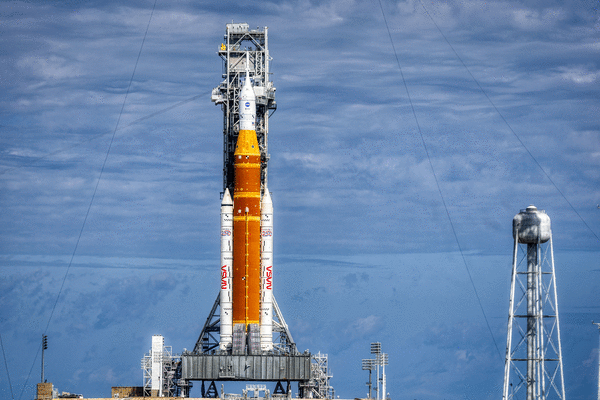
NASA is revising its moon-landing plans, reducing Boeing Co.’s role while elevating SpaceX’s Starship rocket to do the job of propelling astronauts to lunar orbit, people familiar with the matter said.
Under the original plan set years ago, Boeing’s Space Launch System rocket would have sent a crew of four riding inside the Lockheed Martin Corp.-built Orion crew capsule to the moon, with the spacecraft then putting itself in the moon’s orbit. A Starship lander would meet up and dock with the capsule around the moon, before taking astronauts down to the lunar surface.
With the new proposal, SLS would no longer be used to boost Orion close to the moon — previously a key task for the rocket. Instead, Starship and Orion would dock in Earth orbit, giving Starship the pivotal role of propelling the capsule to the moon’s orbit, before taking astronauts down to the surface.
NASA Administrator Jared Isaacman plans to meet on Tuesday with the companies working on Artemis and the human landing system program (HLS), including Blue Origin LLC, Boeing and SpaceX, to discuss their progress and the latest plans at the agency. Any changes to the mission could face Congressional scrutiny, and the agency could reverse and alter its plans, said the people, who asked not to be identified as the matter is confidential.
If NASA diminishes the key role of SLS, the rocket will still be used to launch Orion into Earth orbit, the people said.
“NASA is committed to using the SLS architecture through at least Artemis V, which is necessary to support both HLS providers, and their associated acceleration plans to return American astronauts to the moon,” Isaacman said in a statement provided by an agency spokesperson.
“We’re incredibly supportive of both our HLS providers and their plans to accelerate America’s path forward to the moon,” Isaacman added.
Representatives for Boeing, SpaceX and Blue Origin didn’t immediately comment.
“Orion is the only vehicle capable of returning astronauts from the moon, and is essential for the Artemis program,” said a Lockheed spokesperson. “We’re deep into the assembly of spacecraft for Artemis III, IV and V — all of which are multipurpose and can accommodate NASA’s evolving missions.”
The consideration is part of a broader effort to accelerate the Artemis program to put humans back on the moon for the first time in more than half a century in 2028 — an effort plagued for years by delays and cost overruns.
NASA has been weighing alternatives for landing astronauts on the moon from SpaceX and Blue Origin, founded by Amazon.com Inc. Executive Chair Jeff Bezos. Both companies hold multibillion-dollar contracts to develop moon landers for Artemis.
That would mark another setback for a Boeing program that has anchored NASA’s signature human spaceflight mission. It would also introduce a new challenge: Elon Musk-led SpaceX has only two years to complete development of a rocket that has yet to carry out a successful end-to-end orbital flight, let alone carry a crew.
Shares of Boeing briefly extended declines beyond 3% in New York trading after Bloomberg’s report, before paring losses.
Subscribe Now: The Business of Space newsletter, delivering the inside stories of investments beyond Earth, from satellite networks to moon landings.
SLS and Orion have long served as the primary rocket and backbone of NASA’s Artemis lunar program.
But Orion’s Europe-built propulsion capabilities are limited and Boeing’s rocket is years behind schedule and billions of dollars over budget. NASA’s inspector general estimated the first four flights of the SLS and Orion together would cost more than $4 billion each.
The rocket is on the cusp of launching on its second flight as early as April for a mission called Artemis II, which will send a crew of four astronauts around the moon.
Blue Origin has also submitted its own revised lunar lander plan, after NASA called on the company and SpaceX to move more quickly with their development last year.
Since then, the space agency has seriously considered various options for changing its approach to the moon landing with both SpaceX and Blue Origin’s landers.
However, the plan to use Starship to propel Orion to the moon has been approved, according to a person familiar with the matter. A revised Blue Origin landing plan also has backing, the person said. The role of SLS in that mission isn’t clear.
The new SpaceX landing plan would also rely on sending Orion to a different orbit around the moon than the one NASA had originally planned to use.
The original roadmap would have called for Orion to get into an extremely stretched orbit around the moon known as near-rectilinear halo orbit, or NRHO. Instead, the revisions would call for Starship to propel Orion into a much tighter, circular orbit known as low-lunar orbit.
The reworked SpaceX flight plan is designed to leverage Starship’s potential capability of putting Orion in low-lunar orbit, something that SLS and Orion couldn’t quite achieve together.
Meanwhile, SpaceX’s Starship has also come under criticism for missing its development milestones, and a recent report from NASA’s inspector general found that more delays to the rocket’s development are likely.
The potential latest revisions come after Isaacman announced a significant revamp of NASA’s Artemis program at the end of February.
—With assistance from Ted Mann and Sana Pashankar.
(Adds further detail in fifth paragraph.)
©2026 Bloomberg L.P. Visit bloomberg.com. Distributed by Tribune Content Agency, LLC.










Comments