Auto review: Chevy Bolt 2.0 is back 'n' better
Published in Business News
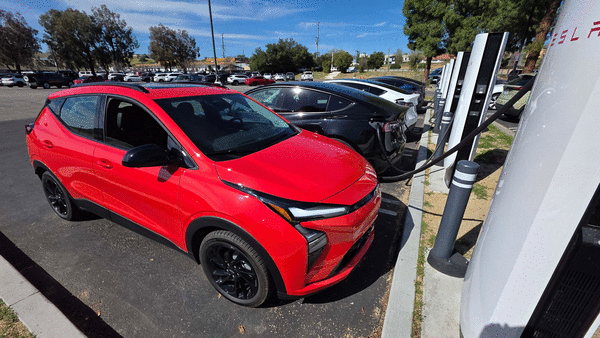
WESTLAKE, California — My 2027 Chevrolet Bolt tester is a cutie. Dressed in Habanero Orange, it merged onto Highway 101. ZOT! I nailed the throttle and instant electric torque launched me like, well, a bolt into early morning traffic north of Los Angeles.
“Hey, Google,” I barked while looking at the 13% state of battery charge. “Take me to a charging station.”
A Tesla station four miles away in Agoura Hills popped up on the 11-inch infotainment screen. I punched the NAVIGATE TO button, then self-drive.
The wheel glowed green and I removed my hands while Habanero Bolt took over driving duties at 70 mph. I reached into my grocery bag (stored in the spacious console tray at my feet) and pulled out a Snapple. The wee Chevy automatically moved to the left lane to pass slower traffic, then methodically worked its way right across three lanes before handing the driving duties back to me at my freeway exit. Thanks, buddy.
ZOT! I was back on the throttle ‘round a cloverleaf. Fun, fun, fun. In its second generation, Bolt has finally come into its own.
Born for the 2017 model year as GM’s first all-electric car, Bolt carried outsized expectations on its small, subcompact shoulders. With government EV mandates looming, GM thrust Bolt into the spotlight as an industry-changing pioneer. Take a ride down last decade’s memory lane:
CHEVY BOLT SALES CRUSHING TESLA MODEL 3 SALES — Business Insider
APPLE’S STEVE WOZNIAK LIKES CHEVY BOLT EV BETTER THAN TESLA MODEL 3 — Yahoo! Autos
BILL NYE THE SCIENCE GUY BUYS A 2017 BOLT EV — GM Authority
GAME CHANGER? EV CHEVY BOLT NAMED 2017 CAR OF THE YEAR — NBC News
Reality never lived up to the hype. While Tesla’s iPhone-on-wheels became a six-figure sales sensation, Bolt became a niche product (like other EVs), as you would expect from a front-wheel-drive subcompact.
It averaged 25,000 sales a year before Chevy canceled it in 2023. But like good niche cars (think Ford Mustang, Chrysler Pacifica, Mazda Miata), Bolt had built a passionate fan base (including GM CEO and Bolt owner Mary Barra), which demanded the cutie’s return.
Bolt is back for 2027. Not as a revolution, but as a fun urban car in Skittle colors.
Gone is the OG Bolt hatchback that split duty with its more SUV-like Bolt EUV (electric utility vehicle) twin beginning in 2022. The '27 Bolt is the EUV carry-over. Like the terrific $23,495 Trax subcompact that is the appetizer to Chevrolet’s internal-combustion-engine SUV menu, the entry-level $28,995 Bolt is head-turning, roomy, loaded with standard features. Among my favorite Chevy features? Thoughtful steering wheel ergonomics with a raised toggle for adaptive cruise control on the front spoke, and buttons for volume/station tuning on the back side.
Unlike Trax, the pricier Bolt is more premium like other Chevy EV entrees Equinox, Blazer and Silverado (consistent with the higher incomes of EV buyers). Compared to Trax, it has 25% better acceleration, 40% less driving range, hand-free driving capability, clever storage cubbies, no Apple CarPlay/Android Auto, and state-of-the-art Google Built-in to map your charging trips.
In short, Bolt is a big personality for the small EV segment.
Reintroducing itself as the industry’s cheapest EV, Bolt undercuts the (also much-improved) Nissan Leaf by $2,500. But Bolt is hardly a cheap build. It’s the lowest-priced vehicle to offer hands-free driving (Super Cruise) in the market (optioned at $32K).
That’s a healthy $6K under Tesla (which offers its hands-free (Full Self-Driving) feature for $99 a month), and a smart way for GM to introduce an addictive, high-tech feature available across its Chevy/Cadillac/GMC lineup.
I’m addicted.
I’ve owned FSD in all three of my Teslas, and GM’s tech is not far behind. The General has been more cautious in building out its Super Cruise network of mapped roads — whereas my Model 3 will self-drive as soon as I leave the driveway. But Bolt’s state-of-the-art Super Cruise 2.0 (with OTA updates) is adding more secondary roads to complement divided highways.
Super Cruise helped take the stress out of crowded LA highway driving. The kids love it, but so do seniors who are attracted to self-driving as a backup safety driver.
Turn off Super Cruise and Bolt comes to life with its short wheelbase and peppy torque. No wonder Chevy has introduced new colors for Gen 2 including Habanero, Atomic Yellow (my favorite) and Marina Blue.
Sounds like the ol’ Ford Focus ST, yes? I like the hot hatch analogy. Dress Bolt in Skittle colors and a new-for-2027 blacked-out RS package, and Bolt won’t be out of place as a local autocross, where its instant torque might torch an unsuspecting ST. I autocrossed a Bolt back in 2016 and had a blast.
Most Bolt owners will use it as an urban driver. I squeezed its small size into a crowded LA convenience store lot (try that in a Silverado EV) and easily sat behind myself with 39 inches of rear-seat room (three inches better than my favorite Mazda CX-30 subcompact SUV).
Those who venture beyond the ‘burbs will welcome Bolt’s much-improved charging speed and access to Tesla chargers with a standard NACS charging port. Sure, some will miss Apple CarPlay/Android Auto, but Google Built-in is a better EV fit.
“Hey Google, navigate to Las Vegas,” I commanded.
Google Built-in immediately charted my seven-hour, 15-minute journey, including two charging stops. That’s 1.15 hours longer than, say, a Trax ICE would make the trip — a reminder of EV road trip shortcomings. In California, fast charging is more expensive than gas (even at $5.33 a gallon, per AAA).
The Agoura Hills charger, for example, cost 72 cents per kWh, which means a Bolt would set you back $72 to fill for a 300-mile trip compared to Trax at $50 (and that’s not including common congestion charges that can increase EV rates by 50%). Rates are cheaper in Michigan, but — at 37 cents/kWh — a Bolt would cost $37 on a 300-mile road trip versus the Trax’s $32 at $3.50-a-gallon gas. Ouch.
Google Built-in makes trips a heckuva lot easier than just a few years ago, though, when I had to consult a third-party app to make a trip. Worse, Bolt could only charge at a snail-like 55 kW at so-called CCS charging stations. While shivering at a West Branch CCS charger in the back of a Ford dealer parking lot in January 2024, a couple rolled up in their gen-one Bolt on the way to the UP with just 10% of range left.
They had a looooong night ahead.
My 2027 tester, meanwhile, filled up much more quickly at (up to) 150 kWh at the Tesla charger (10-80% in 25 minutes assuming minimal congestion) which is not much different than I’ve experienced with my Model 3 (thought the latter can hit peaks of 250 kW). Bolt has also caught up with the Tesla with a Lithium-ion Phosphate battery that can be charged to 100% without battery degradation (compared to 80% on Gen 1).
Payne, all this EV minutiae is making my brain hurt! I’m buying ICE!
I get it, dear reader, which is why the more-efficient Trax has outsold Bolt 5:1. But for the EV faithful, Bolt 2.0 is a better buy. Just look for the Skittle colors.
2027 Chevrolet Bolt EV
Vehicle type: Battery-powered, front-wheel-drive, five-passenger hatchback
Price: $29,995, including $1,395 destination fee ($38,990 RS as tested)
Powerplant: 65 kWh lithium-iron-phosphate battery with single-electric-motor drive
Power: 210 horsepower, 169 pound-feet of torque
Transmission: Single-speed automatic
Performance: 0-60 mph, 6.8 seconds (Car and Driver est.); top speed, 93 mph
Weight: 3,776 pounds
Fuel economy: EPA est. (NA); range, 262 miles
Report card
Highs: Perky acceleration, high-tech tools
Lows: No AWD for Michigan winters; $6K more than gas Trax
Overall: 3 stars
____
©2026 www.detroitnews.com. Visit at detroitnews.com. Distributed by Tribune Content Agency, LLC.










Comments