Nevada files court brief in support of Maryland gaming fight
Published in Business News
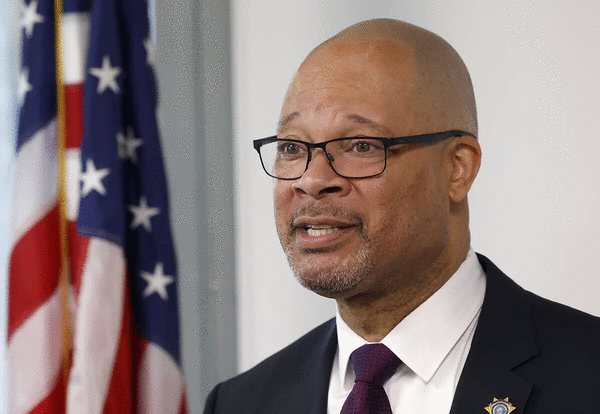
The Nevada attorney general’s office has filed a “friend of the court” brief on behalf of the state of Maryland in its continuing battle against prediction markets that are taking sports bets the state says are in violation of Nevada gaming laws.
Nevada Attorney General Aaron Ford on Monday formally filed a 49-page amicus brief co-sponsored by Ohio Attorney General Dave Yost on behalf of 38 states and the District of Columbia.
Ford’s brief supports the state of Maryland which, like Nevada, has been sued by KalshiEx LLC, which offers prediction markets on the outcome of sporting events which states contend closely resemble sports wagers.
Maryland’s case from U.S. District Court in Maryland has been appealed by Kalshi to the Fourth Circuit Court of the U.S. Court of Appeals.
Ford’s office is litigating a similar court case in Nevada’s U.S. District Court.
In Nevada, U.S. District Court Judge Andrew Gordon in November granted a state motion to dissolve a preliminary injunction that had allowed Kalshi to offer contracts on sporting events until the case was decided in court. While the Nevada Gaming Control Board negotiated terms that keep two other companies offering prediction markets from operating – Robinhood and crypto.com — Kalshi refused to comply and continues to offer contracts in the state pending its Nevada appeal to the Ninth Circuit Court.
Ford, in his brief, explained that Kalshi began offering online sports betting on its online platform in January.
“This activity, unsurprisingly, caught the states’ attention,” the brief says. “The states have long regulated gambling, including sports betting. In some states, sports betting is simply illegal, while in other states, it is allowed but comprehensively regulated. Nonetheless, Kalshi says that state gambling laws do not matter to its activities. That is so, Kalshi argues, because of financial legislation Congress enacted 15 years ago.”
But the brief argues that “courts expect Congress to speak clearly when it intends to shift this country’s traditional balance of power. It follows that Congress could not have removed the states’ traditional authority over sports betting without even mentioning the subject.”
The brief also said Congress is expected “to speak clearly if it intends to give a federal agency unprecedented authority over significant topics. That doctrine also matters here, as Kalshi’s position would delegate to a federal commission the authority to set nationwide sports-gambling policy. If Congress really wanted to delegate that much power, it would not have kept the matter a secret.”
Several of the states that have signed on to the brief offer legal sports betting, but others, including Nevada neighbors California and Utah, do not.
States that have signed on to the brief include Alabama, Alaska, Arizona, Arkansas, California, Colorado, Connecticut, Delaware, Hawaii, Idaho, Illinois, Indiana, Iowa, Kansas, Louisiana, Maine, Massachusetts, Michigan, Minnesota, Mississippi, Nebraska, Nevada, New Jersey, New Mexico, New York, North Carolina, Ohio, Oklahoma, Oregon, Pennsylvania, Rhode Island, South Carolina, South Dakota, Tennessee, Utah, Vermont, Washington, Wisconsin and the District of Columbia.
_____
©2025 Las Vegas Review-Journal. Visit reviewjournal.com.. Distributed by Tribune Content Agency, LLC.

Comments